BTE Newsletter #38: The Rise of the Total Portfolio Approach

Good morning everyone, and Happy Tuesday Wednesday.
First, the most important update: my 5-year old son is making good progress with his broken leg, and is now in a walking boot. So we're still on track for his full recovery before the start of senior kindergarten. That means he only will have lost one summer, but what's the value of that anyways?
As for the Private Markets world, I've been meaning to write a piece on the Total Portfolio Approach for a while. It's a subject that's gained increased attention in the institutional investing world, with organizations like CPP being key advocates. The Chartered Alternative Investment Analyst (CAIA) Association has also been putting out plenty of thought pieces on TPA, and the ideas behind TPA may be coming for individual investors too.
So on Thursday I wrote a teaser LinkedIn post on TPA, and quite a few people weighed in. Comments included "So much for accountability", "People are so gullible", "TPA is nothing new; it’s a marketing term", and "Ruse." ... Perhaps I touched a nerve. Worse still, I mistakenly wrote "institutional" instead of "individual" investors at the top of the post 🤦♂️.
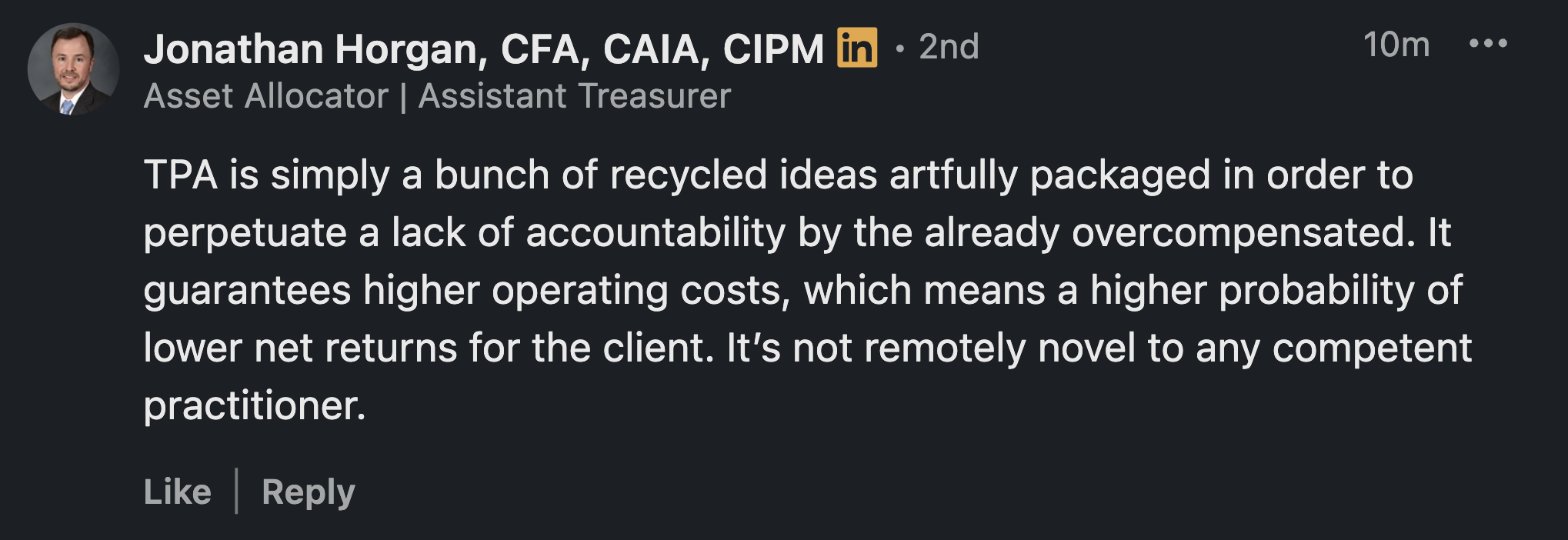
Now to be clear, if I ever see myself as advocating for a ruse, or I believe I'm just promoting a marketing term, or I'm afraid of negative comments, then I'll stop writing on that subject. So with that said, I hope you enjoy this piece on TPA.
Is the Total Portfolio Approach Coming for Individual Investors?
In the world of institutional investing, building portfolios has traditionally been done through a framework known as Strategic Asset Allocation (SAA).
In this framework, capital is allocated into different buckets (e.g. public equities, private credit, venture capital, etc.), each of which are managed in isolation. The result is a fragmented process, with very siloed decision-making. If a certain strategy becomes less favourable, then it can be difficult to adapt, since that asset class's allocation has already been determined. And if a new investment presents itself that doesn't neatly fit into any of those buckets, it can be difficult to evaluate that investment properly.
Contrast that with the Total Portfolio Approach (TPA), which starts with the portfolio objectives (risk, return, liquidity, ESG factors, etc.), and then evaluates each new investment's contribution to those objectives.
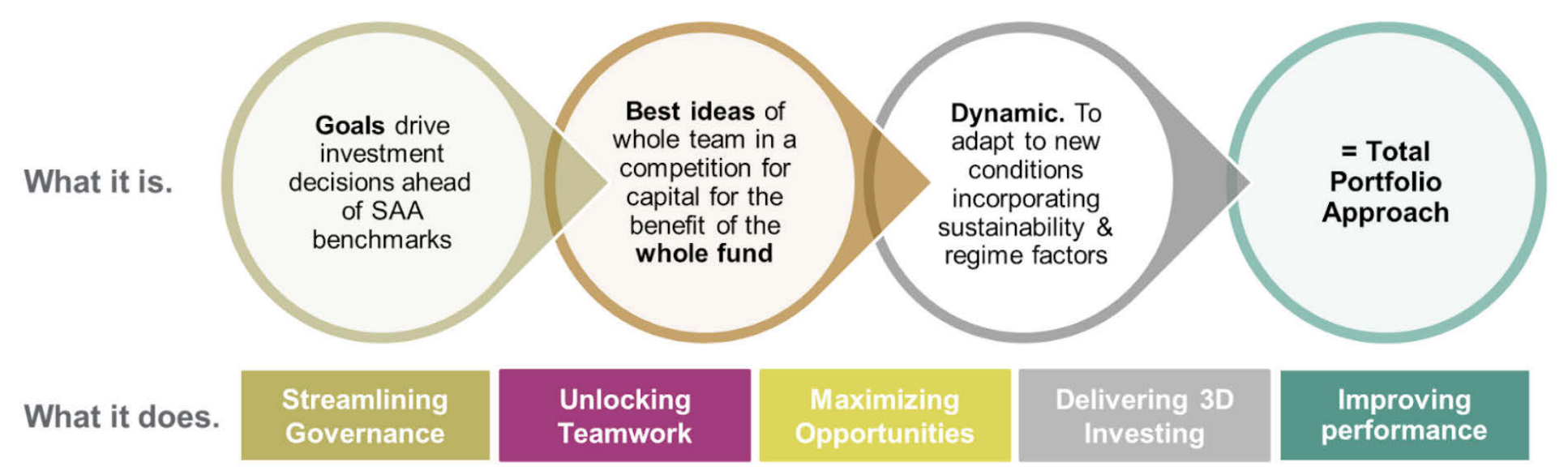
TPA has a number of advantages. It's a more holistic approach, and allows investors to be more flexible as well. Investors can more easily evaluate unconventional investments. Asset class allocations can be ramped up and down more easily. There's a better view about how different investments interact with each other.
To illustrate the difference, consider the following scenarios:
- An investor decides venture capital is no longer worth the elevated risk. But after divesting from VC, the expected risk and return of the portfolio is reduced. So the investor reallocates from pubic bonds to public stocks to compensate.
- An investor considers an investment fund with a Hybrid strategy, which could be thought of as part debt and part equity. Despite having more risk than credit, and a lower return profile than equity, the investor determines the risk/reward ratio of the strategy is favourable, and invests in the fund.
- After a selloff in public REITs, an investor shifts his allocation from private REITs to public REITs, maintaining similar underlying exposures while also exploiting discounted valuations in the public REIT space.
- An investor decides that emerging market small caps are the most attractive public equities available. So after shifting public equity exposure in that direction, the fund shifts its private credit exposure from majority sub-investment grade to majority investment-grade to maintain the same overall risk level.
- An investor decides that his investment portfolio doesn't need so much liquidity. So he shifts from public equities to private equity, seeking greater return with similar underlying exposures.
- An investor determines that despite a particular fund's mediocre performance, it acts as a strong enough diversifier with the rest of the portfolio.
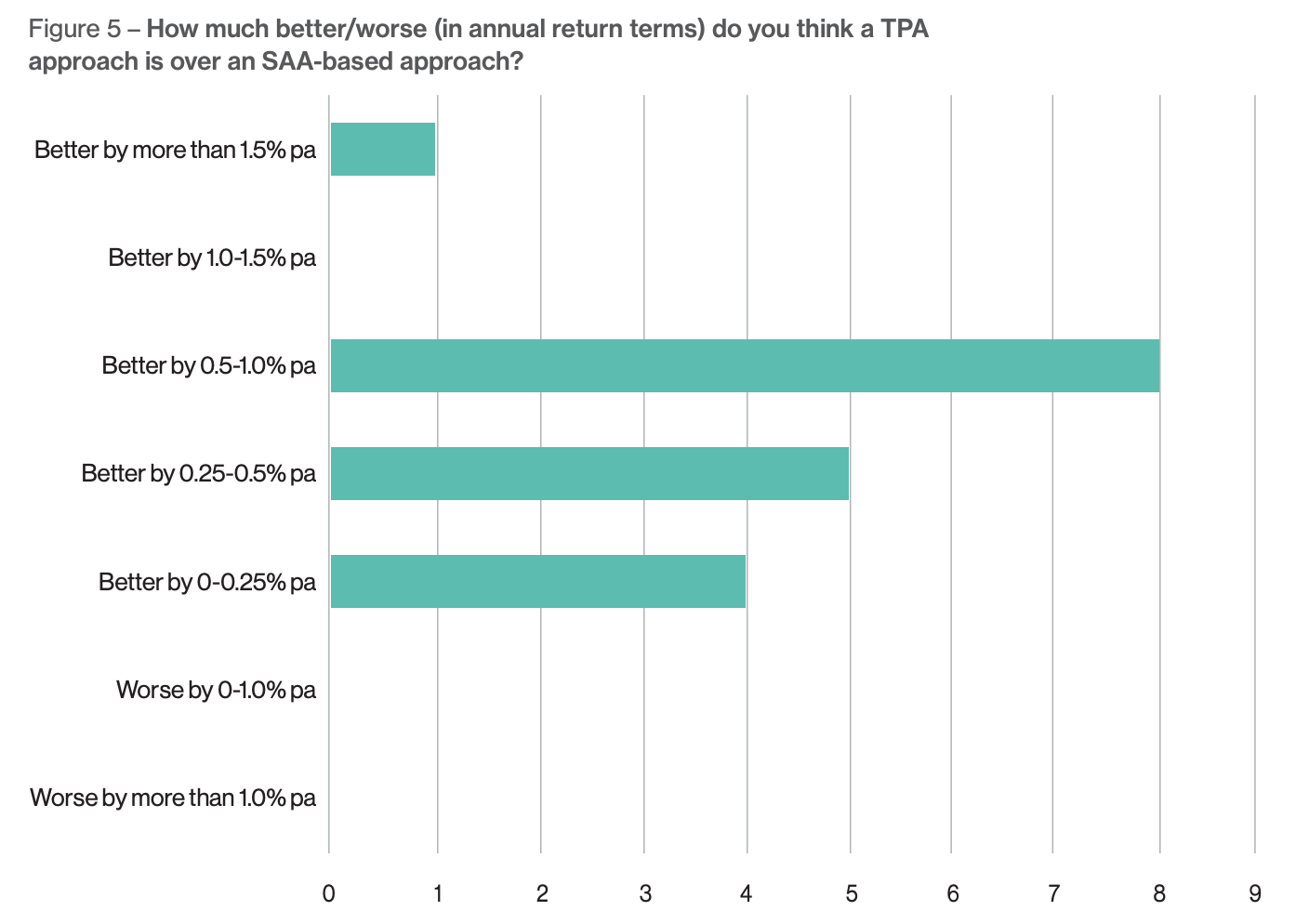
I would argue all of these scenarios are easier under a TPA framework. And according to an institutional investor survey by Willis Towers Watson, respondents generally expect a boost in returns from implementing TPA. More recently, a CAIA report pegged the so-called "TPA Alpha" at 1.7 percentage points per year.
The Institutional Shift to TPA
Shifting from SAA to TPA is not a simple endeavour. It requires overhauling the governance structure and creating a system where the leaders are still held accountable (which is not always done perfectly). Even in organizations where TPA is already in place, it can also be easy to blame TPA for any governance failures (although I consider this unfair).
Nevertheless, institutional investors seem to be slowly embracing the idea. The most notable example is CalPERS, the largest public pension in the U.S., with new CIO Stephen Gilmore estimating TPA will add 0.5-0.6% to investment performance annually. The board voted unanimously to adopt TPA in November, with implementation beginning at the start of this month.
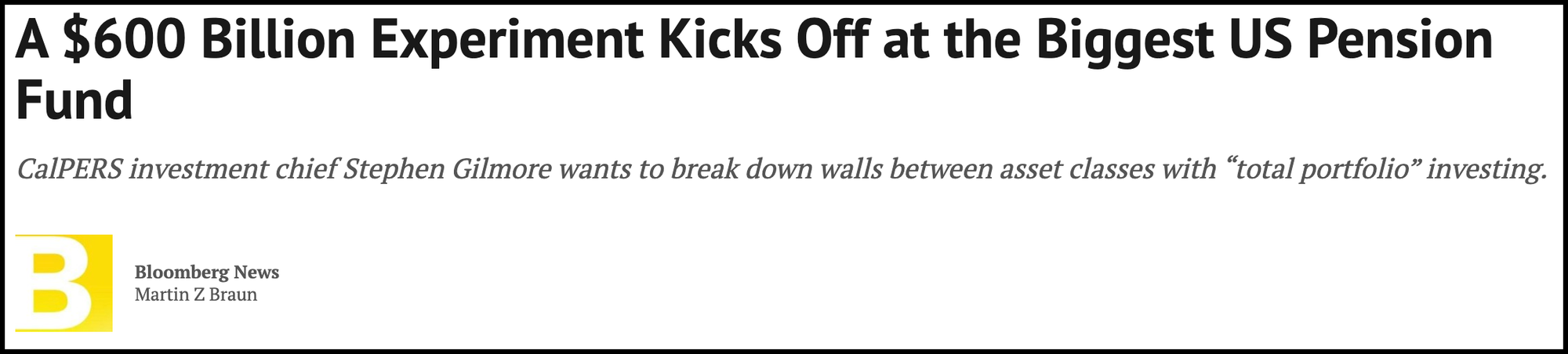
Under the new framework, CalPERS has adopted a reference portfolio of 75% equities and 25% bonds, which is being used as the benchmark. The previous framework used 11 benchmarks across various asset classes.
Can Individual Investors Adopt TPA? Should They?
The short answer is: not entirely. In particular, one of the hallmarks of TPA is its governance structure, and setting standards for how different investment teams work together. Whether an individual is managing money on his own, or using an advisor, governance structures are not relevant in the same way.
And historically, individuals have had very limited investing options, which makes the flexible approach of TPA less impactful. If an investor is only deciding between stocks and bonds, then the types of scenarios mentioned above (with unique asset classes and tradeoffs among many different investing strategies) become much more difficult.
But with the growth of Private Markets, things have changed. More strategies are available, there are more ways to diversify, and there are other considerations (i.e. liquidity). At the very least, the flexibility from a TPA mindset has become more relevant than in years past, especially when evaluating new investing strategies that don't fit into traditional categories.
There are also limits. With Private Markets in particular, these strategies tend to have higher risk ratings than public securities. This is perfectly fair, and is meant to prevent the wrong people from investing in these strategies, but can also limit the flexibility of a TPA mindset. For instance, a lower-risk strategy within Private Markets may still have a higher risk rating (simply because it is illiquid), thus limiting an investor's ability to use that strategy effectively.
But at the very least, one can still take a holistic view of a portfolio, have a flexible mindset, and remain accountable along the way (whether one uses a TPA label or not). And taking this approach is more important than ever before.
Want to find out more?
Private markets are not for everyone, and come with a number of risks, such as higher illiquidity and less transparency.
However, many of the world’s leading institutions and wealthiest families put a big emphasis on private markets, and recently these strategies have become more available to individuals too. Drawing on my background as an analyst specializing in private markets, I help investors cut through the complexity and understand how to build portfolios incorporating these strategies.
To explore whether these strategies are suitable for you, please schedule a 30-minute virtual meeting below:

Email
|

Phone
|

LinkedIn
|

Apple
|

Spotify
|
Disclaimer
Benjamin Sinclair is a representative of Designed Securities Ltd. Designed Securities Ltd. is regulated by the Canadian Investment Regulatory Organization (ciro.ca) and is a Member of the Canadian Investor Protection Fund (cipf.ca). Investment products are provided by Designed Securities Ltd. and include, but are not limited to, mutual funds, stocks, and bonds. Benjamin Sinclair is registered to provide advice and solutions to clients residing in the province of Ontario. For more information, please see www.beyondtheexchange.ca/disclaimer/