BTE Newsletter #44: What Exactly is Vanguard Doing?
Good morning everyone, and Happy Tuesday Wednesday. I hope you all had a great long weekend. And for those of you with school-aged children, Happy Back-To-School week.
A couple of updates on my end. First, I'm a bit late talking about this, but earlier this summer I was fortunate to appear on the Exit Interview Series with David Prowse of the Shaughnessy Group. We talked about what business owners go through as they sell their business, and also talked about various investment strategies, including Private Markets. For those of you who can't see the video embed below, here is a link.
Secondly, I am working on upgrading my website, which may mean a different newsletter platform.
The fact is, this site has been great for the first year of my practice. I often describe it as a "modern-looking Substack", and it has been great for getting newsletter subscribers. But as my practice has evolved, I need a more conventional site, one that leads with who I am and what I do, rather than "Hi I'm Ben now sign up for my newsletter."
But here's the most important thing: this newsletter will remain in place, and subscribers will not need to sign up again. And I remain committed to educating the public on Private Markets every week, with (almost) no exception. And the newsletter will always remain free.
Anyways, it's important that I pre-announce my efforts here. It's the best way to hold myself accountable. Stay tuned for updates.
Ben
What Is Vanguard Up To, and How Does It Relate to Private Markets?
For anyone unfamiliar with Vanguard, it is the world’s second-largest asset manager after BlackRock, with US$13.3 trillion in AUM as of July 31st.
Vanguard is best-known as the passive investing pioneer, dating back to the industry’s first index fund in 1976 under Jack Bogle. Over the following 50 years, the organization has had a singular mission: lowering costs for investors. What also makes Vanguard unique is its structure as a not-for-profit, which reinforces that mission.
Of course growth is part of this equation; the larger Vanguard becomes, the more economies of scale kick in, and the more fee rates can come down. For most of the firm's history, this has been a powerful reinforcing cycle.
Along the way, Vanguard has stayed true to its roots rather than chase the latest shiny object. At times that has been a problem, the most notable example being a delayed entry into the ETF market, largely due to Mr. Bogle's stubbornness.
For anyone looking to learn more, the Acquired Podcast did a deep dive on Vanguard, which I highly recommend.
Vanguard's current CEO Salim Ramji joined the firm two years ago, after leading the iShares business at BlackRock. He is the first externally-hired CEO at Vanguard, having come from the dreaded for-profit world (prior to BlackRock, Mr. Ramji had a long tenure at McKinsey).
And not coincidentally, Vanguard has become much more commercially assertive during his tenure. Examples include broader international ambitions, larger technology spending, and expanding into more strategies, including active management.
Yet even with Vanguard's increased ambitions, the organization surprised a lot of people last week, announcing the purchase of RIA custodian Altruist. Although the terms were not disclosed, the price tag was a reported US$4 billion, more than double Altruist's last funding round.
Why Vanguard Is Buying Altruist
Altruist, founded in 2018, is a fast-growing challenger in the U.S. RIA custody market. Put simply, when a financial advisor leaves a traditional firm to operate independently, they need a custodian to hold client assets, facilitate trading, and provide the technology and operational infrastructure behind client accounts. Fidelity and Charles Schwab are the dominant incumbents, with combined market share well north of 50%. Altruist has emerged as a notable third player by positioning itself as a modern, advisor-focused alternative.
The combined company would offer financial advisors a more integrated ecosystem, combining both investment products and the custody platform used to manage client portfolios. Of course this has the potential for conflicts of interest, but Vanguard's status as a not-for-profit (should) help mitigate that. Besides, Schwab and Fidelity both have integrated offerings as well, complete with proprietary products, so there is precedent for this type of combination.
In a joint interview with Altruist Founder/CEO Jason Wenk, Mr. Ramji emphasized how the two firms have very similar philosophies, as they both look to lower costs and broaden access to investing. For what it's worth, Vanguard has also emphasized that Altruist will maintain its leadership, brand, and advisor focus, without undue pressure to push Vanguard funds.
Meanwhile Vanguard's brand/reputation will be quite helpful to Altruist as the business looks to get more financial advisor clients. This is a factor that may have held back Altruist up to this point; advisors may feel safer keeping their client assets with a large familiar firm like Schwab or Fidelity; the Vanguard seal of approval will be helpful in closing that gap.
And Private Markets are part of that story.
Vanguard's Private Markets Bet
Back in April 2025, Vanguard made an announcement that would have been very surprising if Jack Bogle were still in charge: the launch of a partnership with Blackstone and Wellington Management. The idea was (and still is) to create new products that combine public and private investments:

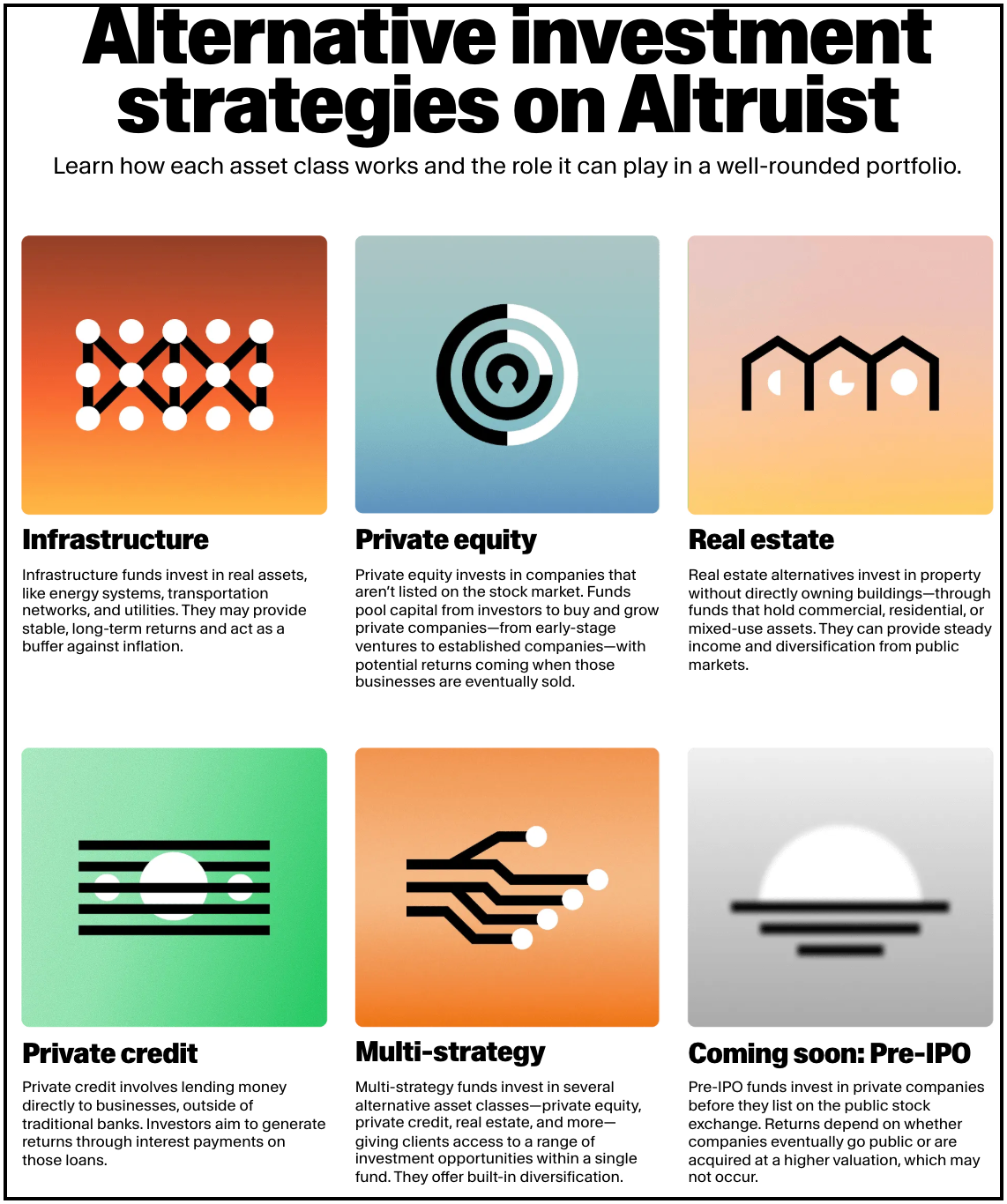
Then at the beginning of June 2026, Altruist launched an alternative investment platform and marketplace, initially in partnership with Blackstone, JPMorgan, KKR and Pantheon. More managers will surely follow, along with other strategies, including the opportunity to invest in pre-IPO companies.
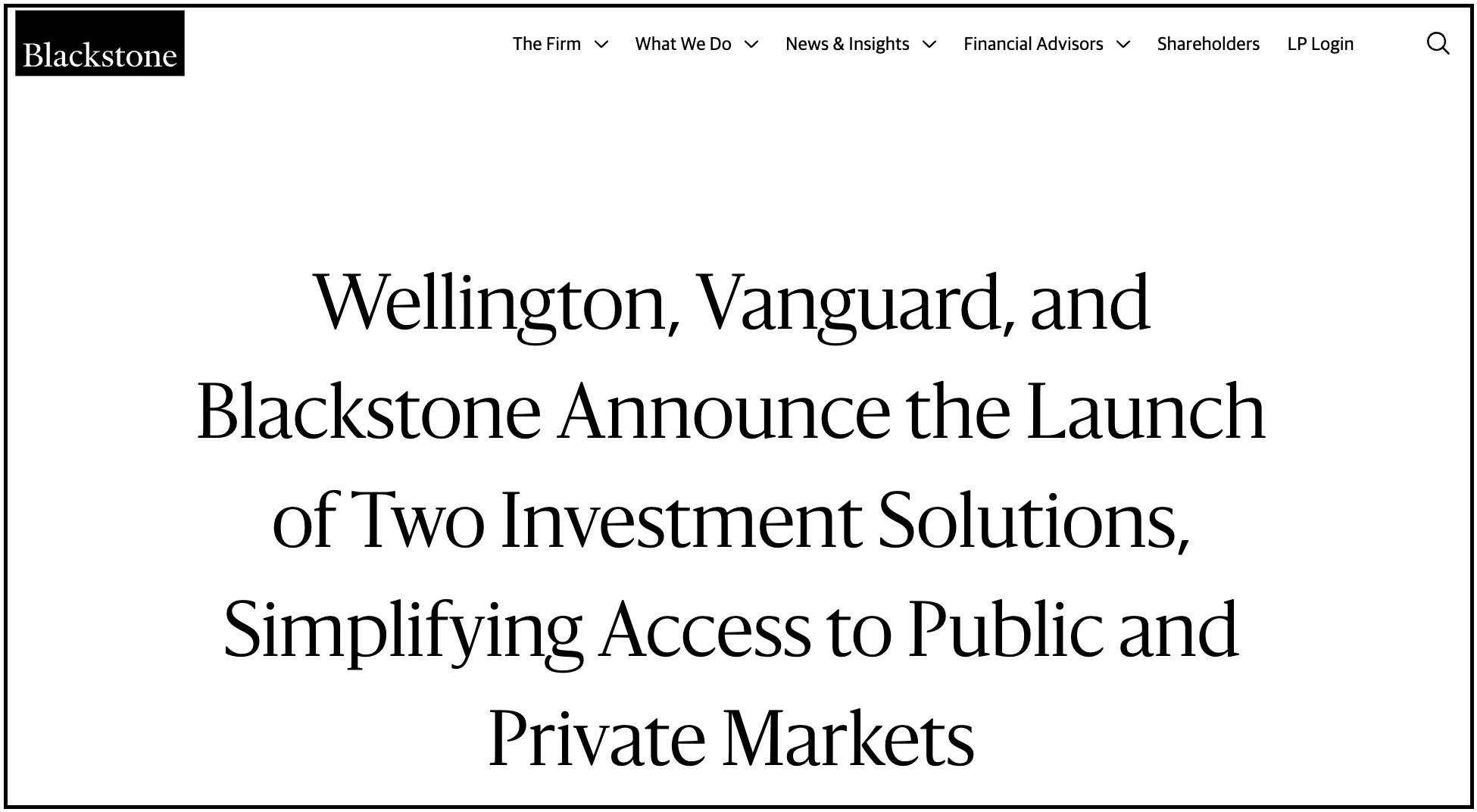
Then in late July, the Blackstone/Vanguard/Wellington partnership announced its first two products. One combines public and private assets into a single fund. The other combines four different Blackstone private strategies.
Then only about a month later, Vanguard and Altruist announced their merger. So it's quite easy to imagine a future where independent financial advisors put their clients' money into Vanguard-sponsored funds combining public and private asset classes, all on a platform owned by Vanguard.
This is part of a larger pattern
Vanguard's actions may not be very popular with purists (i.e. the people who want to see the company stick to its bread and butter low-cost funds). But the company is not acting in isolation.
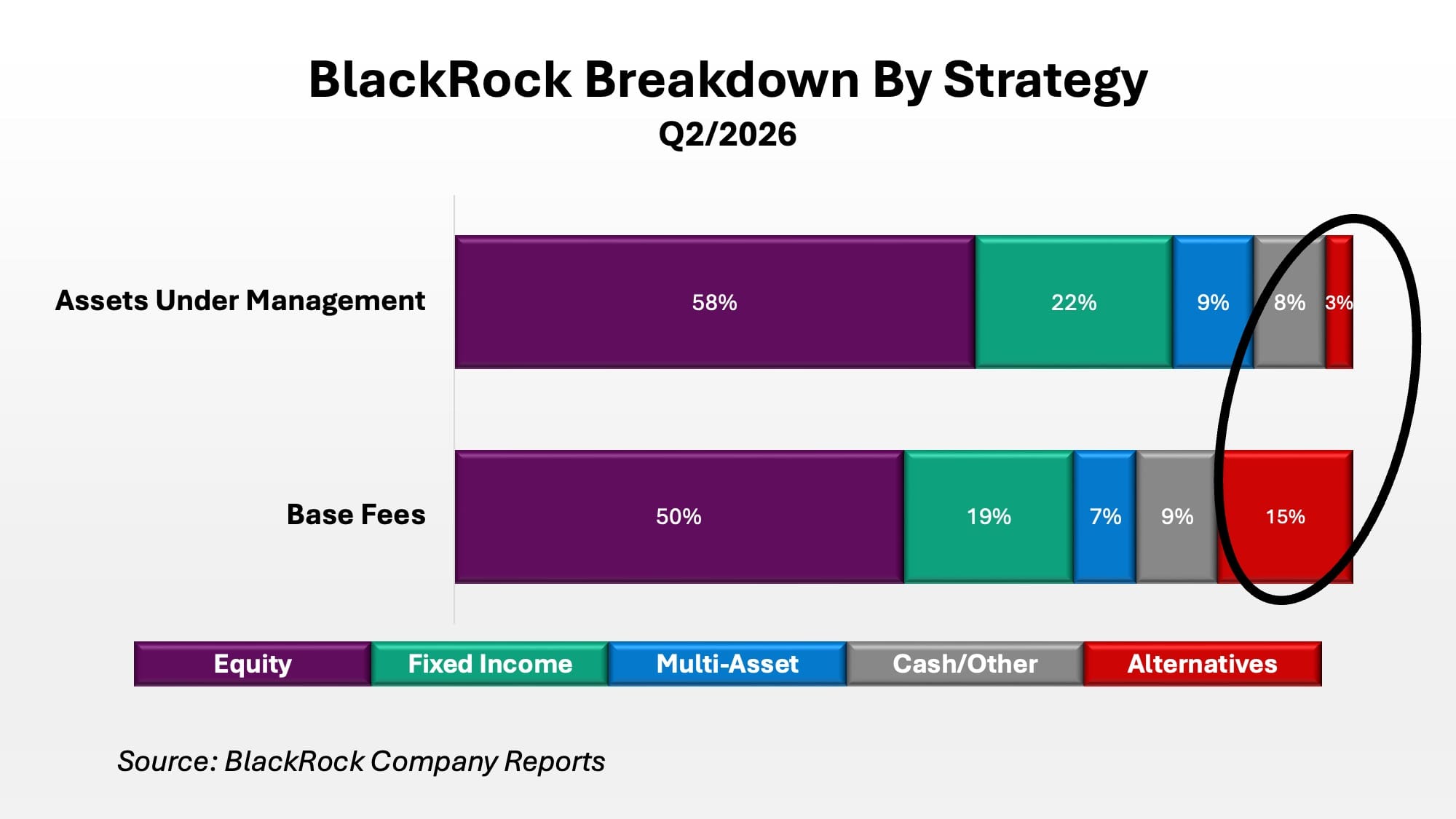
BlackRock is a perfect case in point. The company is the world's largest asset manager, is Vanguard's biggest rival, and is best-known for its iShares suite of ETFs. Yet BlackRock has aggressively moved into alternative investments, punctuated by three large acquisitions announced in the space in 2024. Alternative investments now account for 3% of BlackRock's AUM and 15% of base fees.
Other traditional asset managers have followed a similar strategy. Franklin Templeton has made a slew of acquisitions in the alternative investment space, including Benefit Street Partners (Private Credit), Lexington Partners (Secondaries), and Apera Asset Management (European Private Credit). T Rowe Price made a large acquisition too, acquiring Private Credit specialist Oak Hill Advisors in 2021. North of the border, IGM made a significant investment in Canada's third largest alternative asset manager, Northleaf Capital Partners.
In other cases, firms have gone the partnership route. Capital Group has teamed up with KKR to offer funds that combine public and private asset classes. State Street and Apollo have launched an ETF that marries public and private credit. And despite its acquisitive history, BlackRock signed a partnership with alternative asset manager Partners Group to develop public/private model portfolios.
In all these situations, there are a few common themes:
- Traditional asset managers are not content to stay in their lane, and are determined to participate in the faster-growing alternatives space.
- Distribution is paramount. Whether its the extensive sales teams at traditional asset managers, or owning an RIA custodian in Schwab/Fidelity/Vanguard's case, an extensive distribution network is not just the key to success for a traditional asset manager, but can be especially helpful when diving further into alternatives.
- Products that combine public and private asset classes are here to stay, and investors should expect many more such vehicles to enter the market. For many advisors and their clients, they offer the most practical way to access Private Markets while maintaining some degree of liquidity, diversification, and professional portfolio management.
Conclusion: Even Vanguard Wants In
Getting back to the title of this article, it is quite clear what Vanguard is doing: they are behaving more like their profit-seeking peers, which includes a deeper dive into Private Markets.
This does not mean the organization is straying from its roots. Vanguard can still offer investors access to low-cost investing solutions, but in a more comprehensive way than in years past, and through one of the most prominent technology platforms.
And given Vanguard's history, as well as its not-for-profit structure, one could easily argue they deserve the benefit of the doubt. Just don't expect them to stay in their lane, because no one else in the space is doing that either.
Want to find out more?
Private markets are not for everyone, and come with a number of risks, such as higher illiquidity and less transparency.
However, many of the world’s leading institutions and wealthiest families put a big emphasis on private markets, and recently these strategies have become more available to individuals too. Drawing on my background as an analyst specializing in private markets, I help investors cut through the complexity and understand how to build portfolios incorporating these strategies.
To explore whether these strategies are suitable for you, please schedule a 30-minute virtual meeting below:

Email
|

Phone
|

LinkedIn
|

Apple
|

Spotify
|
Disclaimer
Benjamin Sinclair is a representative of Designed Securities Ltd. Designed Securities Ltd. is regulated by the Canadian Investment Regulatory Organization (ciro.ca) and is a Member of the Canadian Investor Protection Fund (cipf.ca). Investment products are provided by Designed Securities Ltd. and include, but are not limited to, mutual funds, stocks, and bonds. Benjamin Sinclair is registered to provide advice and solutions to clients residing in the province of Ontario. For more information, please see www.beyondtheexchange.ca/disclaimer/

|

|
|