BTE Newsletter #43: The Case For Secondaries, With a Caveat

Good morning everyone, and Happy Tuesday.
First things first, there is an update on the podcast. Episode 14, featuring David Alloune of Trans-Canada Capital, will be released tomorrow morning. And for those of you who prefer reading to listening, I've already uploaded the transcript to the BTE Podcast webpage.
As a refresher, if you're reading this newsletter in your email inbox (i.e. you've already subscribed) then you have access to all podcast episode transcripts. And if you're just a webpage visitor, you know what to do next.


|

|
That said, there was an unfortunate development. The Episode 15 guest had to back out after recording the episode. And for those of you familiar with the podcast, I always get each guest to ask the next guest a question. So that chain has now been broken, and I'll have to start a new one.
But there is some good news: the guest who cancelled feels really bad about it.
Ben
A Closer Look at Secondaries For Individual Investors
For those of you unaware of what Secondaries are, they are Private Market transactions in which an investor buys an existing private asset, rather than committing capital to a newly raised fund. This can involve either acquiring an asset from an existing fund through a GP-led secondary, or purchasing another investor’s interest in a fund through an LP-led secondary.
In an LP-led secondary, an investor may be looking to rebalance their portfolio or raise cash. Since they cannot sell their interest in a Private Markets fund back to the manager, nor can they sell their fund interest on the stock market, they would instead sell their interest to a secondaries investor ... usually at a discount to net asset value (NAV).
In a GP-led secondary, the manager of a Private Markets fund would typically put one or more of the fund's assets in a continuation vehicle (CV). Fund investors would then have the option of investing in the CV or taking cash for their interest in those assets. Most investors choose the cash option, which is where secondary market investors come in to fill the void.
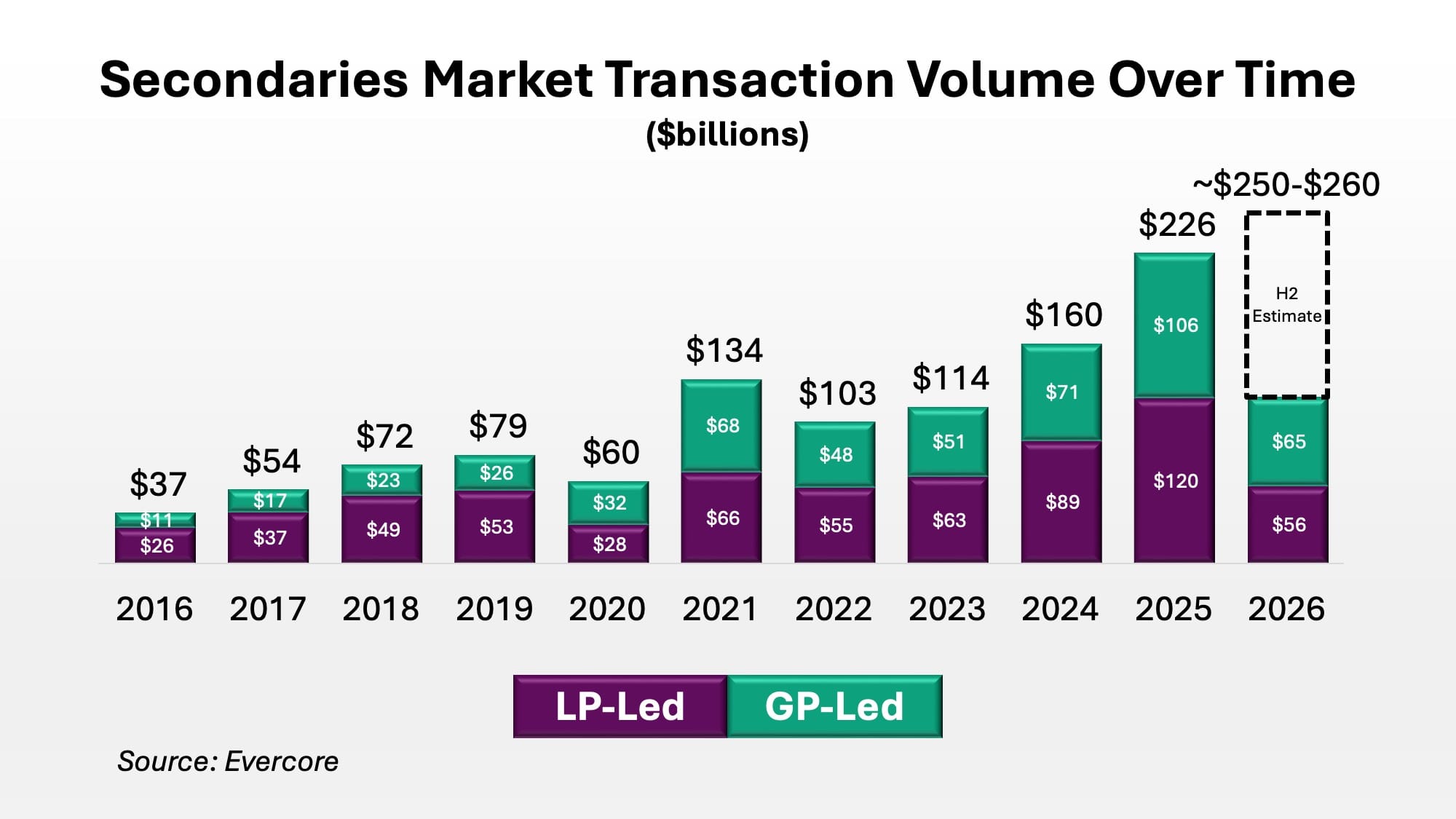
Both forms of secondaries have grown substantially in recent years, with transaction volume expected to reach $250+ billion in 2026.
As an investment, the case for secondaries can be boiled down to these ideas:
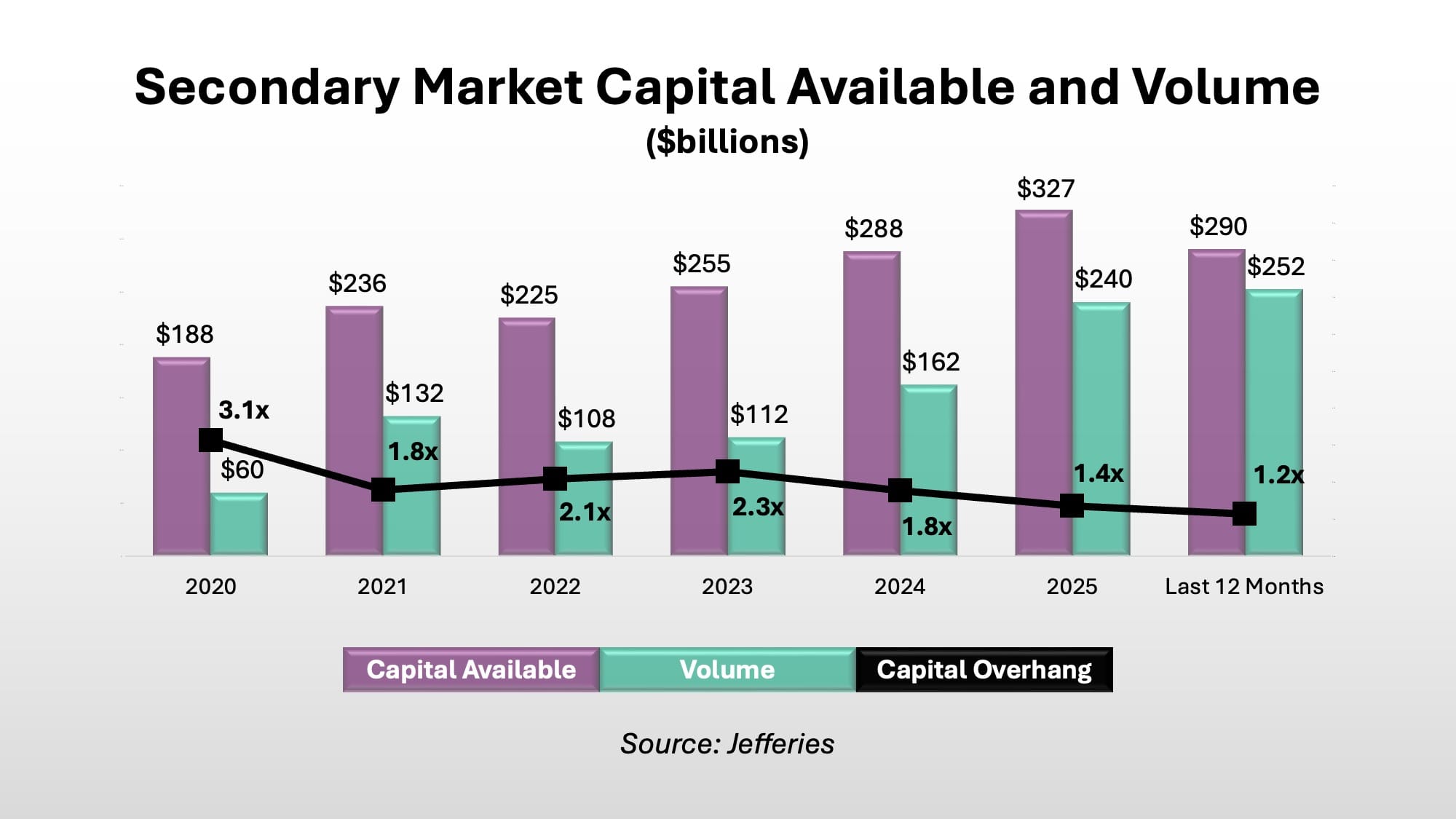
- There is still a limited amount of capital available relative to the demand. If one compares the capital available to the total volume, that number is only about 1.2x, which is well below comparable figures for the Private Equity market, and this number has also declined in recent years. To illustrate, if one compares the year 2020 to the last 12 month period, capital available has increased by just over 50%, but volume has increased four-fold. This dynamic should allow buyers in the secondary market to remain selective and demand favourable terms, especially as liquidity remains tough to come by in today's Private Equity environment.
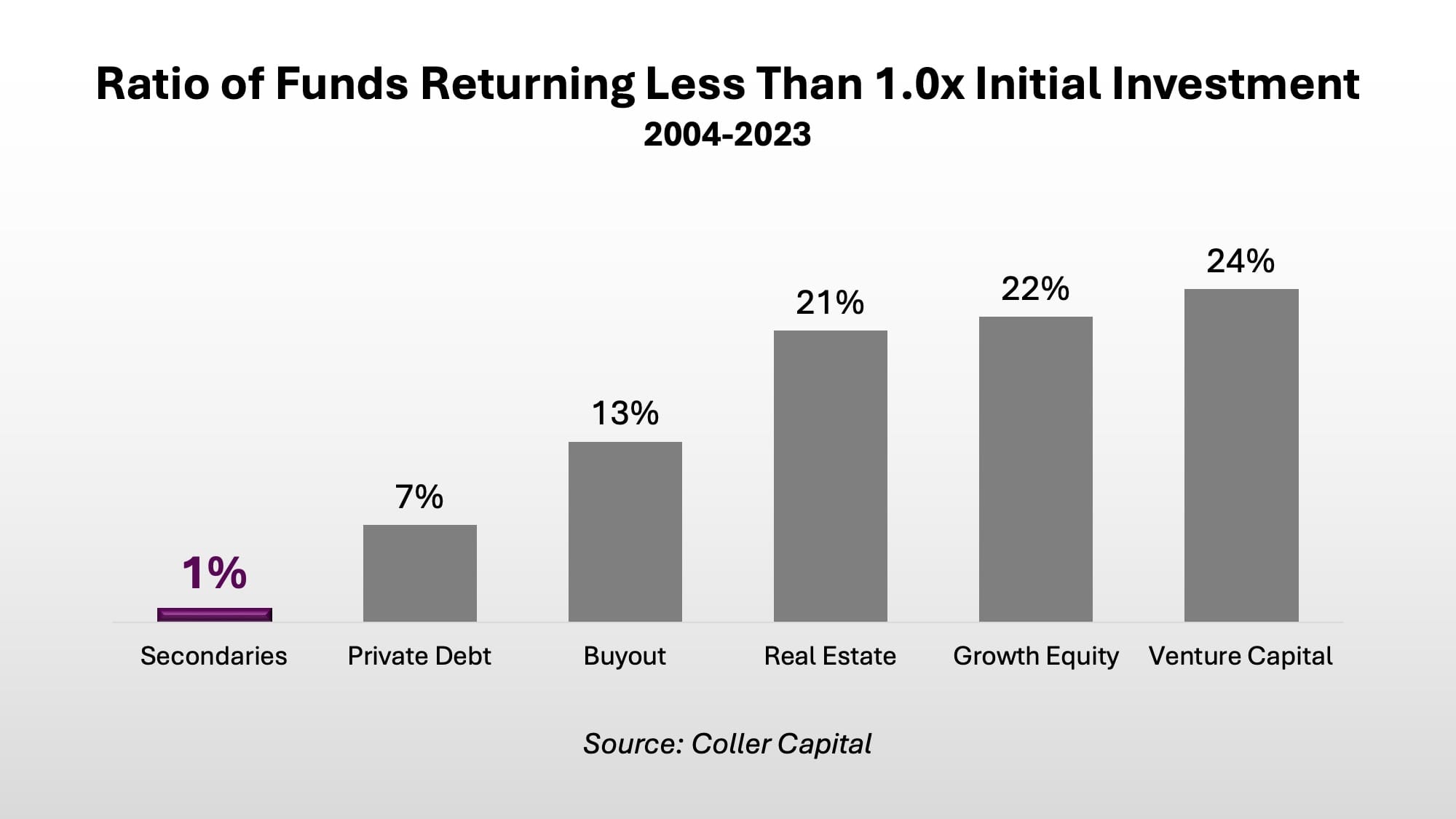
- There is less variability around returns. If one considers the typical life cycle of a Private Equity investment, the early period is characterized by heavy investment and high uncertainty as a business is improved. Once that happens, cash flows turn positive in later years, a phenomenon known as the j-curve. But in secondaries transactions, assets are acquired later on in that cycle, which mitigates the j-curve impact and makes for less return uncertainty.
- Diversification is easier to achieve, and diversification is trickier to achieve in traditional Private Equity than in public markets, because individual funds often own only a handful of assets, while investors may face constraints on owning a broad portfolio of funds (high minimums, limited access, etc). Secondaries funds can help address that constraint, particularly through LP-led transactions that provide exposure to a large number of assets through a single purchase. Rather than committing to one Private Equity fund with a concentrated portfolio, an investor may gain access through Secondaries to interests spanning multiple funds, managers, and potentially hundreds of individual businesses.
Why Secondaries Are Particularly Relevant For Evergreen Funds
It all comes down to deal flow. Unlike traditional institutional funds, which call capital only when deals materialize, Evergreen funds receive investor money on an ongoing basis, and need a reliable pipeline to put that capital to work relatively quickly. The same pressure applies when investors want their money back; because Evergreen funds face periodic redemption requests, managers also need practical ways to create liquidity.
This is much easier to achieve in Secondaries, where the top managers have numerous relationships with other Private Markets firms, with investment banks, and with large investors. This makes it a lot easier to invest money quickly when new money comes in, or to raise cash when meeting redemptions.
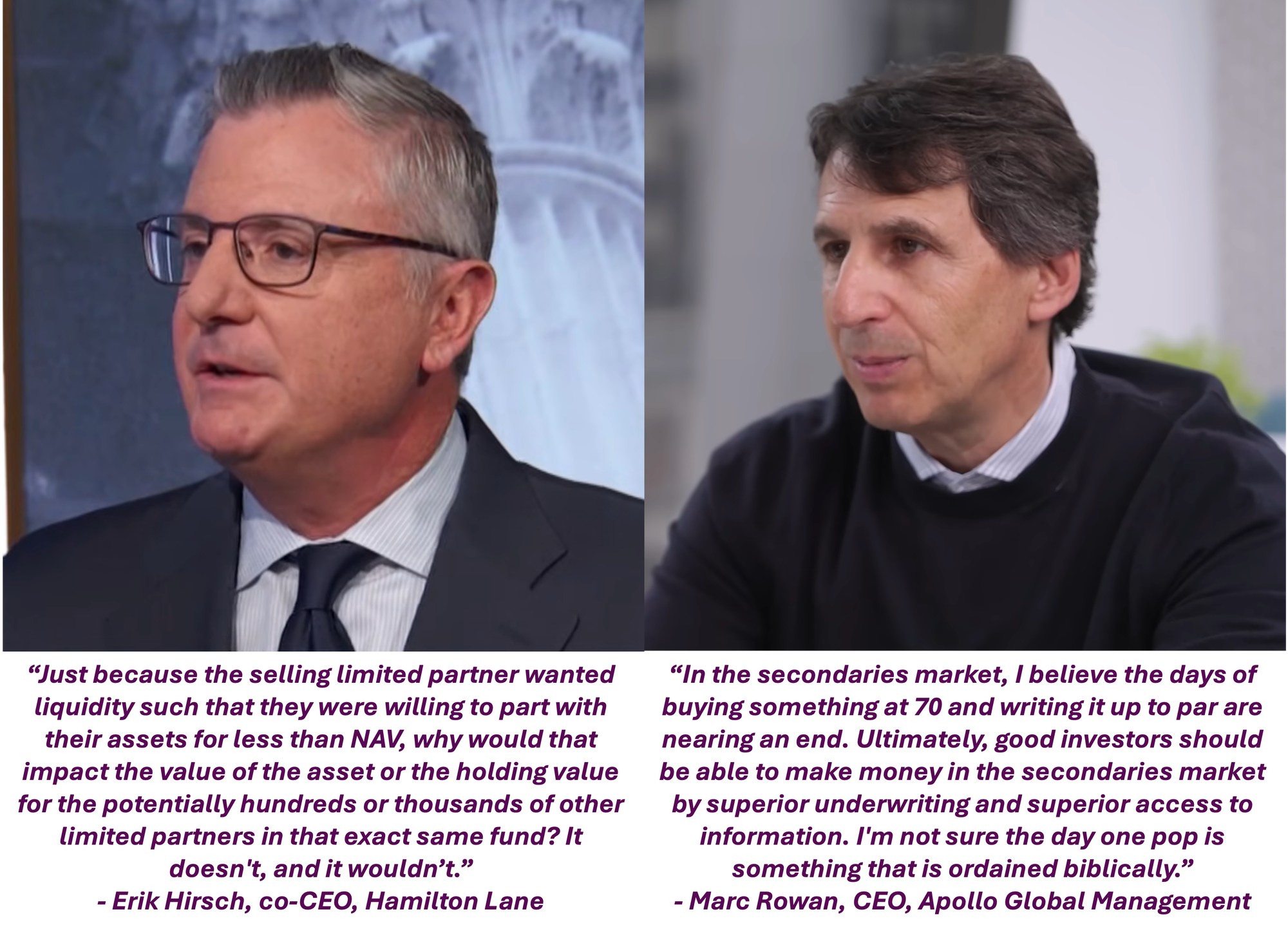
But there is a caveat: valuation. In the secondaries market, most assets are bought at a discount to NAV (particularly in LP-led deals). But then immediately after purchase, they are immediately valued at NAV. This is standard industry practice.
That quick markup matters more in Evergreen funds than in traditional drawdown structures. In a drawdown fund, investors are mainly focused on the cash ultimately returned over the life of the fund, so interim valuations tend to matter less. In an Evergreen vehicle, investors are continually subscribing and redeeming at NAV. So these subscriptions/redemptions can take place using values that don't reflect where the assets just traded.
There is some disagreement in the industry on this practice, and it came to light during Q1/2026 earnings calls, with Hamilton Lane co-CEO Erik Hirsch defending the practice and Apollo CEO Marc Rowan criticizing it:
Beyond Private Equity
Most of the secondaries volume is in Private Equity, but other areas of Private Markets growing rapidly as well. One worth pointing out in particular is Private Credit, where volume increased by more than 50% annually from 2020 to 2025. That momentum has carried through to 2026; volume through the first six months this year has already surpassed volume from all of last year.
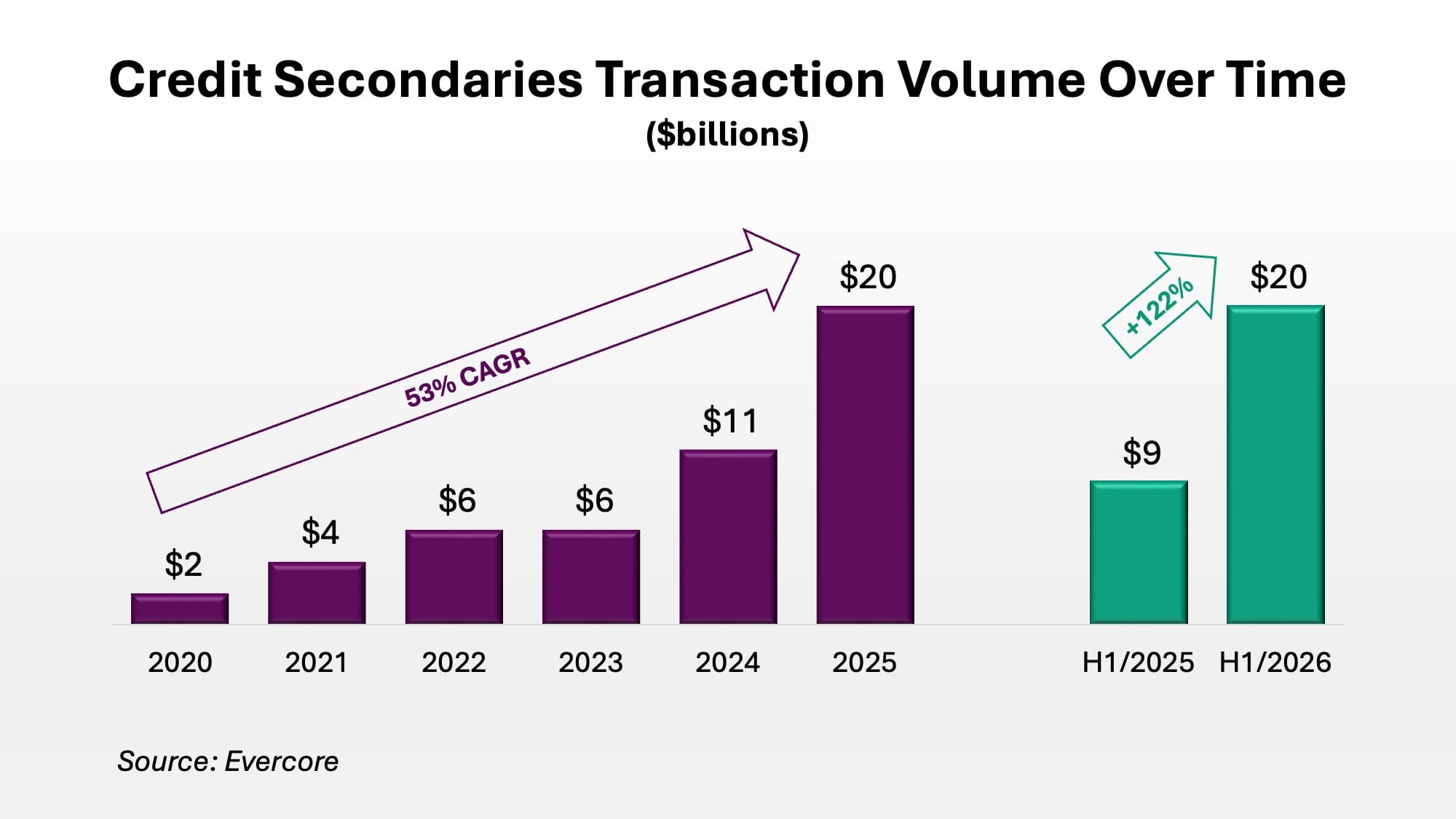
One should expect Credit Secondaries to become increasingly relevant in the years ahead. The first reason is quite simple: the market is less penetrated than Private Equity Secondaries, so there is some catching up to do.
But another reason has to do with the turmoil in Private Credit seen this year. With elevated redemption requests in some Evergreen Private Credit funds, many have been looking to raise cash to meet these redemption requests. The same dynamic has played out in publicly-listed Private Credit funds, including a very large transaction announced in early August involving BlackRock TCP Capital Corp (Nasdaq:TCPC).
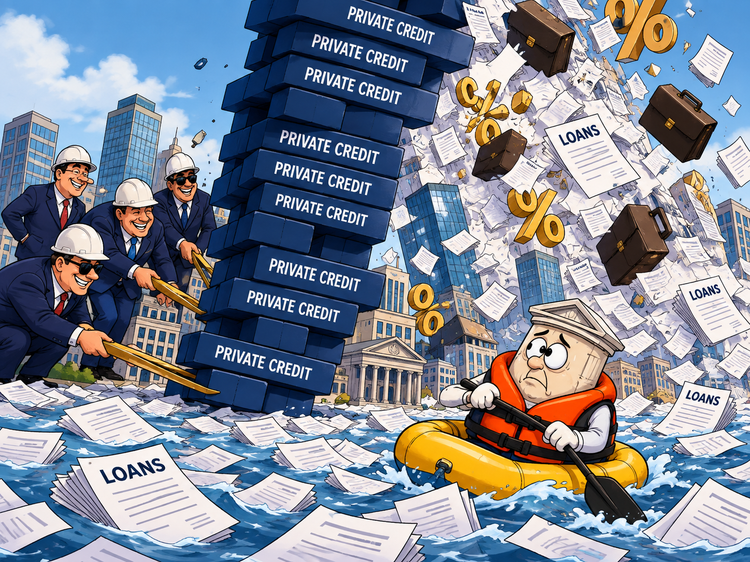
TCPC has been in turmoil for quite a while, as bad loans in an overly concentrated portfolio have led to elevated credit losses. Its share price has declined by more than 70% over the past 5 years, and a month ago, the stock was trading at barely half of NAV. So the company announced the sale of nearly half its loan book at 95 cents on the dollar to Pantheon, a secondaries specialist (I made the infographic below for this LinkedIn post), and despite a NAV hit to TCPC, the stock spiked up in response.
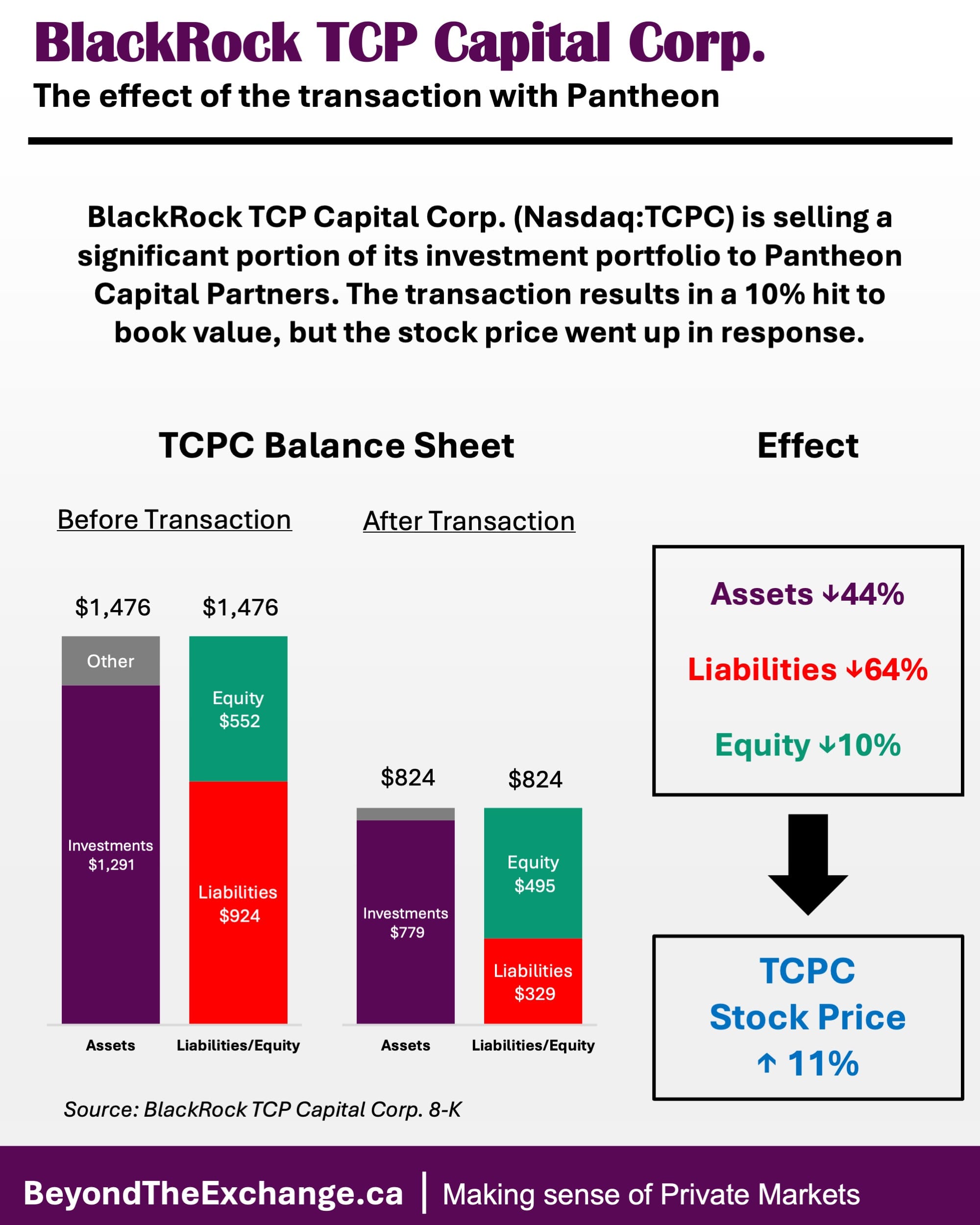
This transaction was just what TCPC needed to repair its balance sheet and boost its stock price. But it was also a great deal for Pantheon, which got to hand pick a portfolio of assets and acquire them at a discount. With so many other Private Credit funds also under strain (albeit most not as severely as TCPC), this should be a great opportunity for Pantheon and other Private Credit Secondaries specialists.
Conclusion: A Great Opportunity, With A Caveat
Putting all this together, Private Markets Secondaries are a very compelling opportunity for individual investors. The industry is still short capital, the return profile is attractive, and diversification is easier to achieve. The strategy is also a particularly strong fit for Evergreen vehicles and individual investors. Furthermore, the strategy is not limited to Private Equity; Credit is also a very fast-growing and compelling asset class in the Secondaries space.
The major caveat is around valuation. Investors should be wary of buying a fund at NAV when the underlying assets transacted at a lower number. This is something that HarbourVest Managing Director Abigail Rayner talked about in our podcast episode recently (the transcript can be seen here, with this topic on page six), and to put it bluntly, some managers are better than others in this regard.
Want to find out more?
Private markets are not for everyone, and come with a number of risks, such as higher illiquidity and less transparency.
However, many of the world’s leading institutions and wealthiest families put a big emphasis on private markets, and recently these strategies have become more available to individuals too. Drawing on my background as an analyst specializing in private markets, I help investors cut through the complexity and understand how to build portfolios incorporating these strategies.
To explore whether these strategies are suitable for you, please schedule a 30-minute virtual meeting below:

Email
|

Phone
|

LinkedIn
|

Apple
|

Spotify
|
Disclaimer
Benjamin Sinclair is a representative of Designed Securities Ltd. Designed Securities Ltd. is regulated by the Canadian Investment Regulatory Organization (ciro.ca) and is a Member of the Canadian Investor Protection Fund (cipf.ca). Investment products are provided by Designed Securities Ltd. and include, but are not limited to, mutual funds, stocks, and bonds. Benjamin Sinclair is registered to provide advice and solutions to clients residing in the province of Ontario. For more information, please see www.beyondtheexchange.ca/disclaimer/

|

|

|