BTE Newsletter #42: Is Private Credit Under Strain?

Good morning everyone, and Happy Tuesday.
It's that time of year when everyone says "Where has the summer gone?". And I can certainly say the same thing, although I am looking forward to the fall as well. There are already a slew of events I've committed to, with hosts ranging from CIBC, Crescero Natural Capital, Designed Wealth Management, HarbourVest Partners, The Private Markets Forum, and the Canadian Association of Alternative Assets & Strategies (CAASA). Also of course I'm looking forward to the start of a new NFL season.
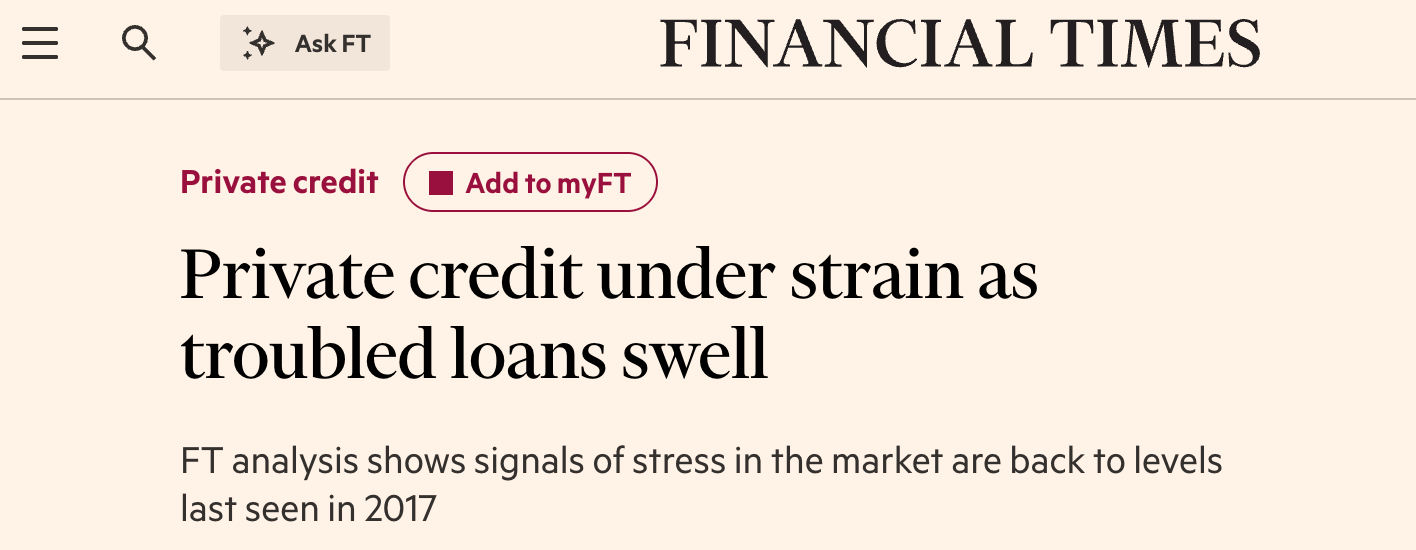
In the meantime, there continue to be plenty of scary headlines about Private Credit. This is nothing new. But this time there are also legitimate signs of increasing loan losses in the industry, and this has made the headlines even scarier:
So below I share my thoughts on what's driving these headlines. Enjoy!
Ben
Are Losses Piling Up in Private Credit?
This year has brought no shortage of challenges in credit markets, from concerns about software lending, to the Iran war, to Private Credit liquidity challenges, to a surge of AI-related issuance, to ongoing tariff battles, not to mention the precarious U.S. fiscal situation. And now headlines are emerging about increasingly troubled loans in Private Credit funds, based on analyses of public Business Development Companies (BDCs).
To understand what is going on, it's worth taking a look at what exactly BDCs are, how they are trending, and the differences between public and private BDCs.
BDCs: An Overview
In the United States, a BDC is a regulated investment vehicle that provides investors access to diversified Private Credit portfolios. It is often compared to a REIT, except rather than owning income-producing real estate, a BDC invests primarily in loans to private companies. Like REITs, BDCs can be public or private.
BDCs can avoid federal tax on income distributed to stockholders, not unlike REITs, but there are a number of requirements to stay compliant, including:
- Investment Limitations: at least 70% of assets must be invested in U.S. non-financial sector operating companies that have no listing, or a market capitalization of less than US$250 million.
- Leverage: a BDC's debt/equity ratio must not exceed 2:1.
- Income Restrictions: at least 90% of income must come from investment sources.
- Distribution Requirements: at least 90% of taxable income must be distributed.
- Valuation: portfolios must be marked at fair value on a quarterly basis.
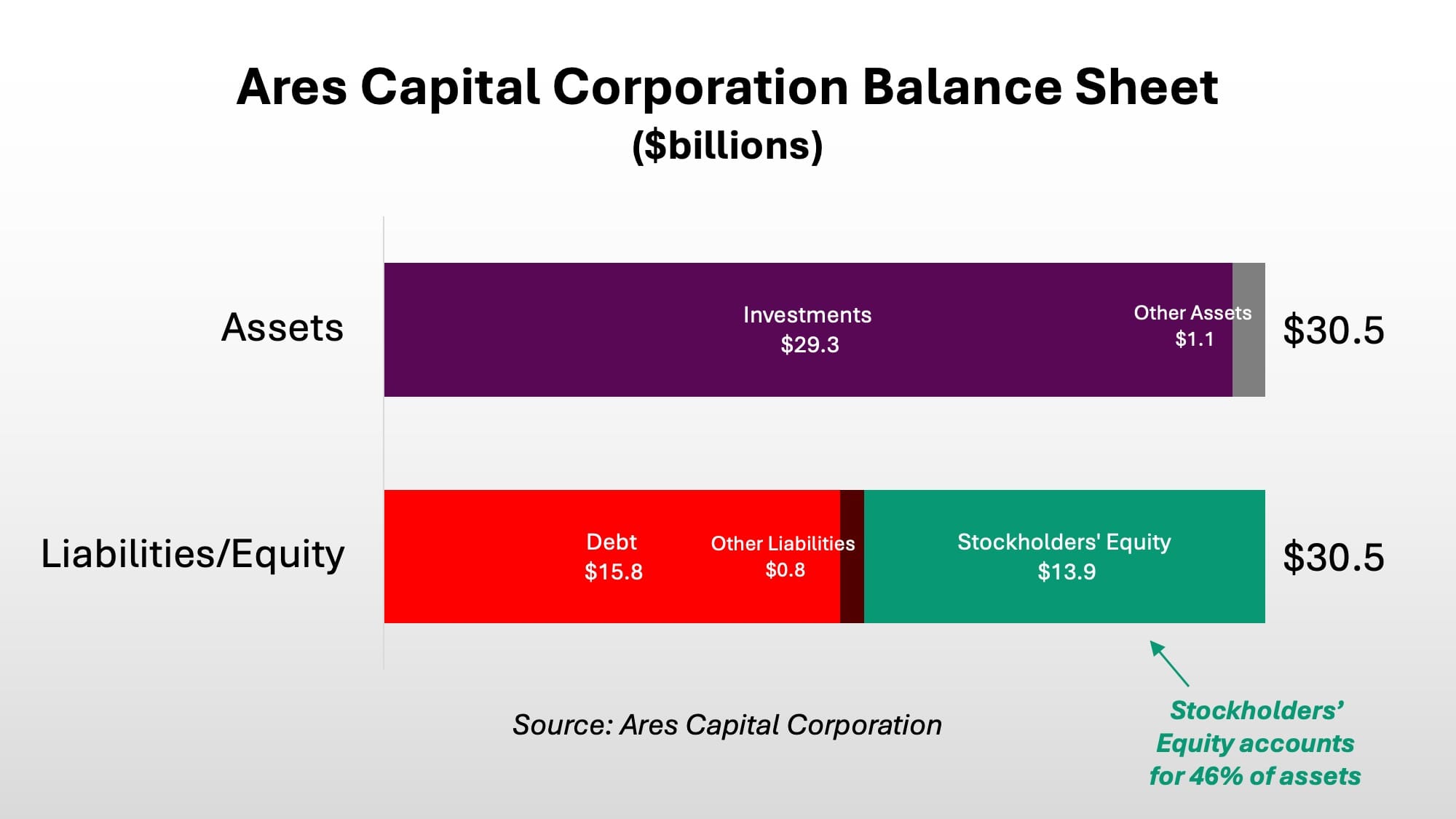
To illustrate how BDCs operate, one can look at the largest publicly-traded BDC as an example: Ares Capital Corporation (Nasdaq:ARCC). The balance sheet is overwhelmingly made up of investment assets, financed slightly more by debt than by equity:
One could compare this model to a bank. Both entities hold investment assets on their balance sheet, and look to earn net investment income (i.e. by earning greater return on their investment assets than on their liabilities). But banks are far more levered than BDCs, which is apparent when looking at JPMorgan's balance sheet:
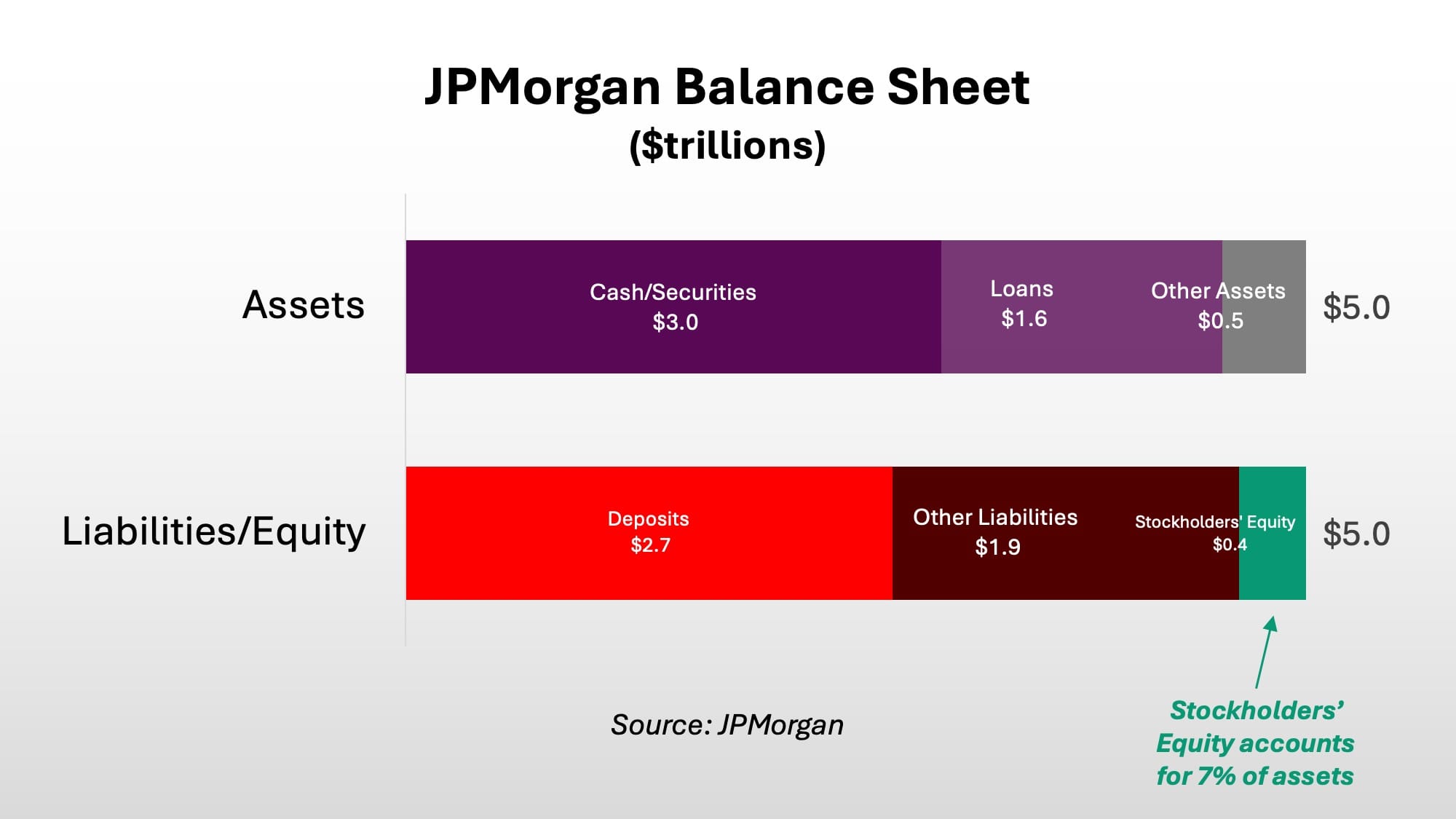
When just looking at their balance sheets, BDCs look a lot safer. Not only do they use much less leverage, but they also have better asset-liability matching; they don't use short-term liabilities to fund longer-term assets (which is exactly what sunk Silicon Valley Bank and a handful of other banks in 2023).
But BDCs are known to make relatively risky loans, at least compared to the safer forms of lending on bank balance sheets. In fact the BDCs' growth is very much related to the retreat of banks from riskier forms of lending after the Great Financial Crisis. Accordingly, BDCs have a reputation of only providing financing to companies that cannot get cheaper financing from banks, although this characterization is less accurate now than in years past.
Some Worrying Trends
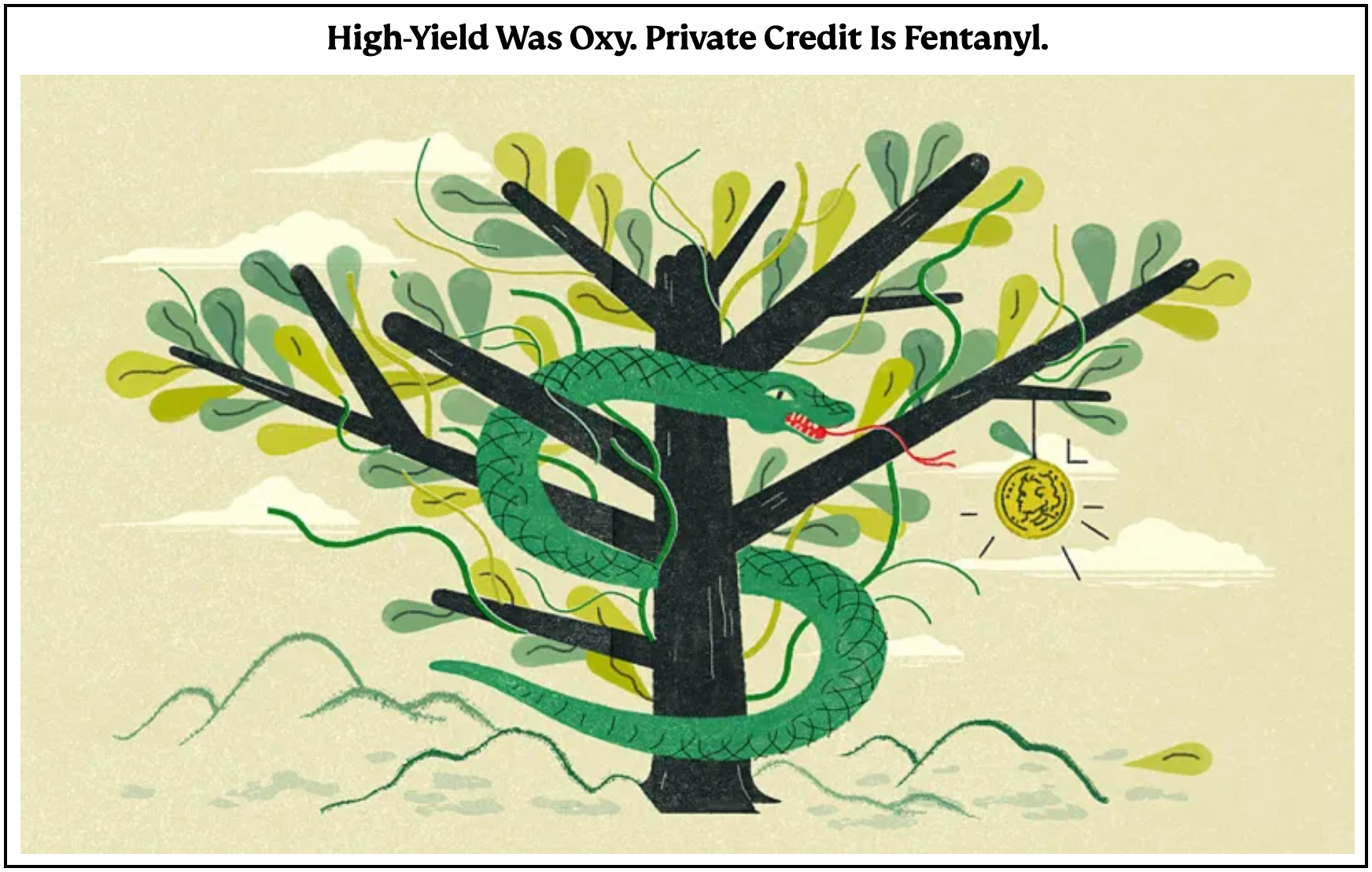
There have been no shortage of headlines over the past ten years warning of Private Credit excesses. My personal favourite is this one from Institutional Investor in January 2020:
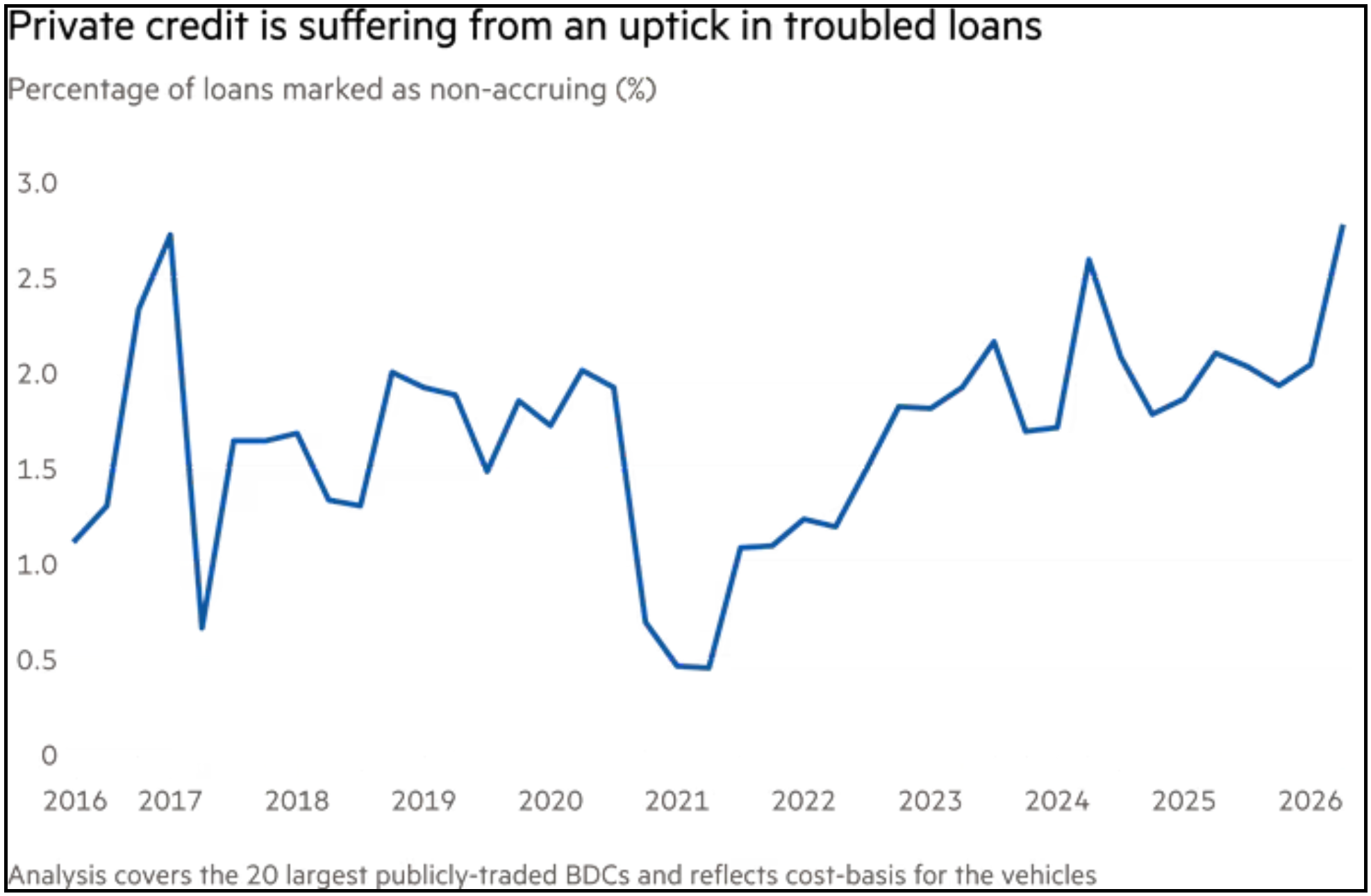
This time the Private Credit skeptics seem to have a lot more ammunition, at least when looking at the largest public BDCs. According to one study by the Financial Times, the rate of non-accruing loans at the 20 largest public BDCs is higher than at any point since 2017.
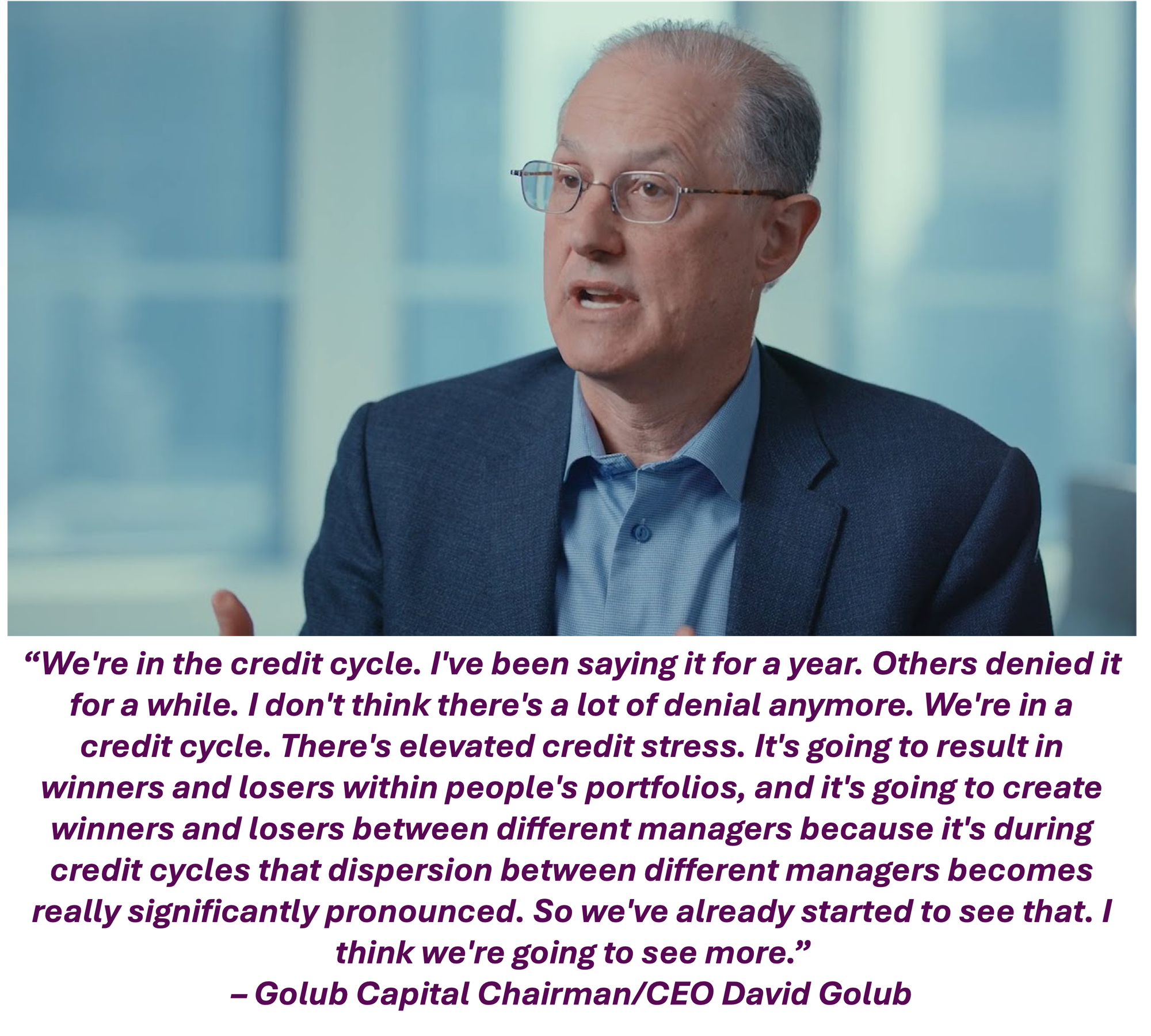
There is also concerning commentary from the BDC managers. During a conference call with analysts, Golub Capital CEO/Chairman David Golub warned of "elevated credit stress" creating "winners and losers within people's portfolios."
Other managers, such as Blue Owl and Ares, are more optimistic. They point out that their borrowers are quite healthy, that the credit events they're seeing are isolated incidents, and that the bulk of their portfolios continue to perform well. Software exposure remains a concern for investors, but thus far software borrowers are generally not seeing a deterioration in their results from AI disruption. The environment has also shifted more in favour of lenders, leading to better spreads and terms from the BDCs' perspectives.
Differences Between Public and Private BDCs
Most of the large public BDC managers also offer private BDCs, with significant overlap between the two portfolios. For example, the Ares Strategic Income Fund (ASIF) sits alongside Ares Capital Corporation (ARCC), with the first one being private and the second being public.
But besides a stock exchange listing, there are other differences between public and private BDCs. One is that public BDC loan portfolios tend to be more risky, with higher levels of junior debt, higher levels of non-accruals, and higher use of Payment-In-Kind (PIK) structures. Public BDCs also tend to use more leverage to juice returns, and they have more portfolio concentration by borrower. Apollo summarized this nicely late last year in an analysis of its peer set.
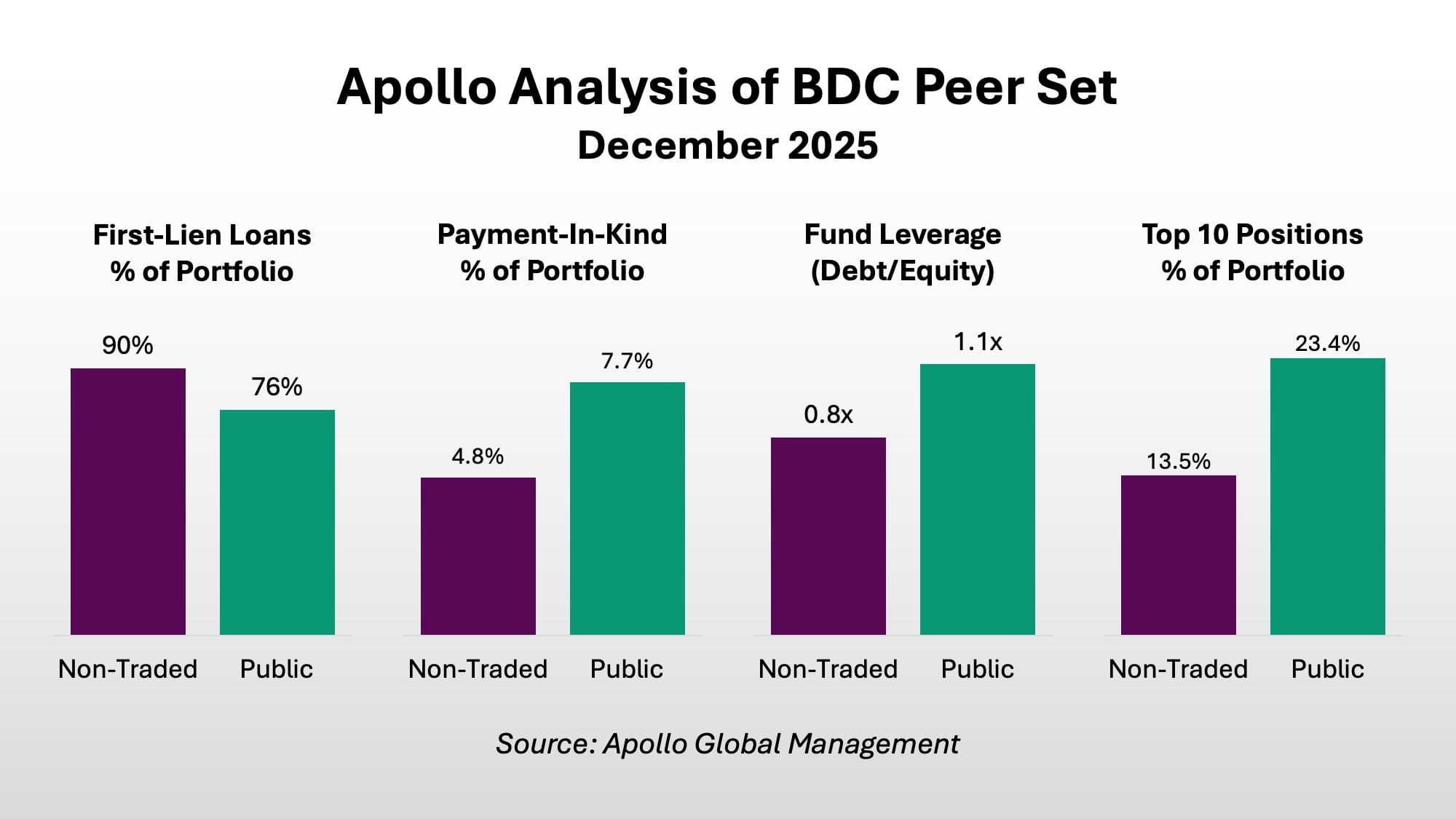
Several factors help explain these differences. Public BDCs charge higher management fees, which requires them to take on more risk to deliver comparable net yields to investors. That risk may come through allocating to lower quality loans with higher spreads, employing greater leverage, or both.
In addition, some public BDCs have longer operating histories than their private counterparts. In cases where managers have strengthened underwriting standards over time, legacy public portfolios may still include loans originated during earlier, less-disciplined underwriting vintages. Blue Owl is one example of this, when comparing OBDC (its pubic BDC) with OCIC (its private BDC).
But this means that analyzing only public BDCs (as the FT did) will inevitably overstate the degree to which loans are deteriorating. And when looking at the entire BDC universe, the picture does not appear so frightening.
The Cliffwater Direct Lending Index (CDLI) is the most widely recognized benchmark of Private Credit loans, using data from both listed and unlisted BDCs. And when looking at the CDLI, the picture is more nuanced. Over the past two years, non-accruals have increased, but remain below 2% (well below the 2.5%+ figure cited in the Financial Times). Over that same period, use of payment-in-kind has slightly decreased, as have realized investment losses and % of assets on watchlist.
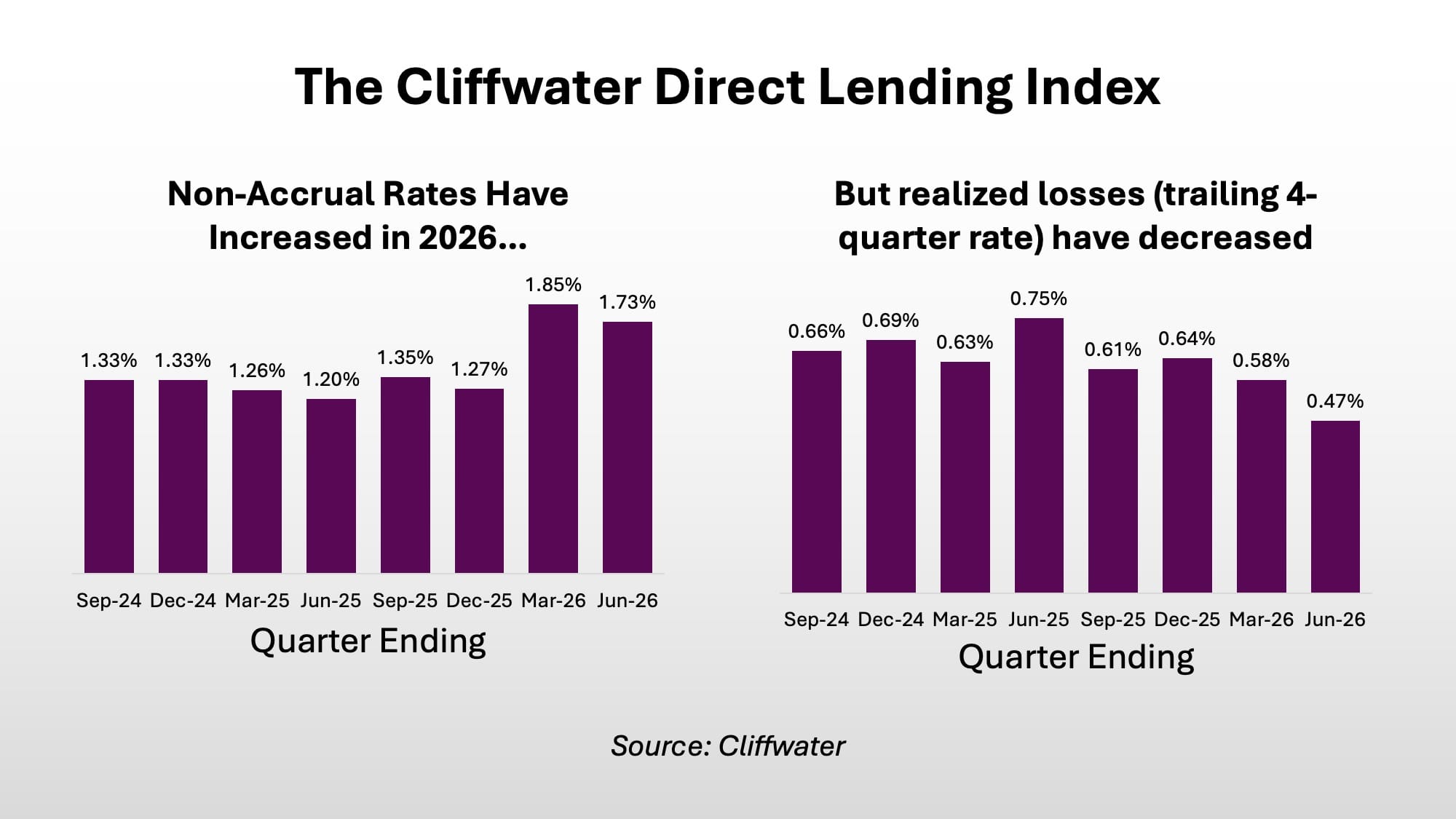
Furthermore, it's important to keep these numbers in context. These loss rates are still well below the index's gross yield, and it's a big reason why the CDLI has only posted a negative return once in more than 20 years (in 2008). Furthermore, because BDCs are not levered nearly as much as banks are, there's less risk of a fund collapsing completely, assuming it's managed properly. And even when a fund is mismanaged (Prospect Capital and TCPC come to mind), there is not enough impact on the financial system for there to be a systemic risk.
In other words, the fentanyl comparison still seems extreme.
The Big Takeaway: The "Golden Age" Has Made Way For Dispersion
The consensus among managers is clear: the dispersion between top- and bottom-performing firms is widening.
Simply operating in private credit is no longer enough. Managers with weak underwriting discipline are increasingly likely to disappoint investors, whether through public or private BDC structures. The same dynamic is playing out across Private Markets more broadly: participation alone is not a strategy. In the current environment, rigorous sourcing, disciplined underwriting, proper portfolio construction, and active portfolio management will determine who delivers strong returns. And for those who don't, they should expect plenty more coverage from the Financial Times.
Want to find out more?
Private markets are not for everyone, and come with a number of risks, such as higher illiquidity and less transparency.
However, many of the world’s leading institutions and wealthiest families put a big emphasis on private markets, and recently these strategies have become more available to individuals too. Drawing on my background as an analyst specializing in private markets, I help investors cut through the complexity and understand how to build portfolios incorporating these strategies.
To explore whether these strategies are suitable for you, please schedule a 30-minute virtual meeting below:

Email
|

Phone
|

LinkedIn
|

Apple
|

Spotify
|
Disclaimer
Benjamin Sinclair is a representative of Designed Securities Ltd. Designed Securities Ltd. is regulated by the Canadian Investment Regulatory Organization (ciro.ca) and is a Member of the Canadian Investor Protection Fund (cipf.ca). Investment products are provided by Designed Securities Ltd. and include, but are not limited to, mutual funds, stocks, and bonds. Benjamin Sinclair is registered to provide advice and solutions to clients residing in the province of Ontario. For more information, please see www.beyondtheexchange.ca/disclaimer/

|

|

|