BTE Newsletter #33: It's Amazing What You Can Get These Days For $2.5 Trillion

Good morning everyone, and Happy Tuesday.
We're now just a couple days away from the webinar I'm hosting on Private Markets (see below).
And in the meantime, today I'll be moderating a panel on Private Credit at the iCapital Engage+ Toronto event. The panel will feature senior leaders from Apollo, Golub, Antares and Morgan Stanley, and given everything that's happened in the world of Private Credit, there should be a lively discussion ... and hopefully some good content for future newsletter issues. To any of you that are going, I'll see you later today.

As for this week's issue, it seems that the SpaceX IPO is all people are talking about, and even though this newsletter is devoted to Private Markets, there are still some good takeaways for all investors. It's also worth taking a step back and looking at the stock market as a whole, which has increasingly been driven by the AI trade (even before the SpaceX IPO).
And besides, I make the rules around here. So for this week's edition of Beyond The Exchange I'll take a look at what's happening On The Exchange.
Ben
Upcoming Webinar: June 18th at 11am

We're just a couple days away now from the upcoming webinar on Private Markets, so this is the last notice to sign up. This webinar will be all about the practicalities of Private Markets for individuals, answering questions such as:
- How do different asset classes such as Private Equity, Credit, Infrastructure and Real Estate compare?
- What kind of criteria are most useful when evaluating Private Markets funds?
- Is there a minimum dollar amount to qualify for these investments?
To be clear, this is free and welcome to everyone. Guests are also anonymous to each other. I hope to see you there.
Some Thoughts on the SpaceX IPO
Ever since starting this newsletter, I've shared a few thoughts about the stock market, and they can be summarized as follows:
- The stock market has become an increasingly concentrated bet on AI, technology, and growth companies.
- The stock market is trading at high valuations by historical standards.
- Because the stock market has performed so well since 2009 (particularly in the U.S.), many people will be caught unprepared when the next bear market arrives.
- Related to the last point, I believe a lot of people are over-allocated to stocks and are overestimating their risk tolerance.
Now with SpaceX public, one could argue the company encapsulates most (if not all) of the trends above.
SpaceX Is Effectively An AI Company Stock
The Space business is what SpaceX is best known for, but in reality it's the AI business that's driving the lofty valuation. This is the business that emanated from the xAI purchase last year for $250 billion, and it accounts for over 90% of the company's total addressable market (according to its IPO filing).
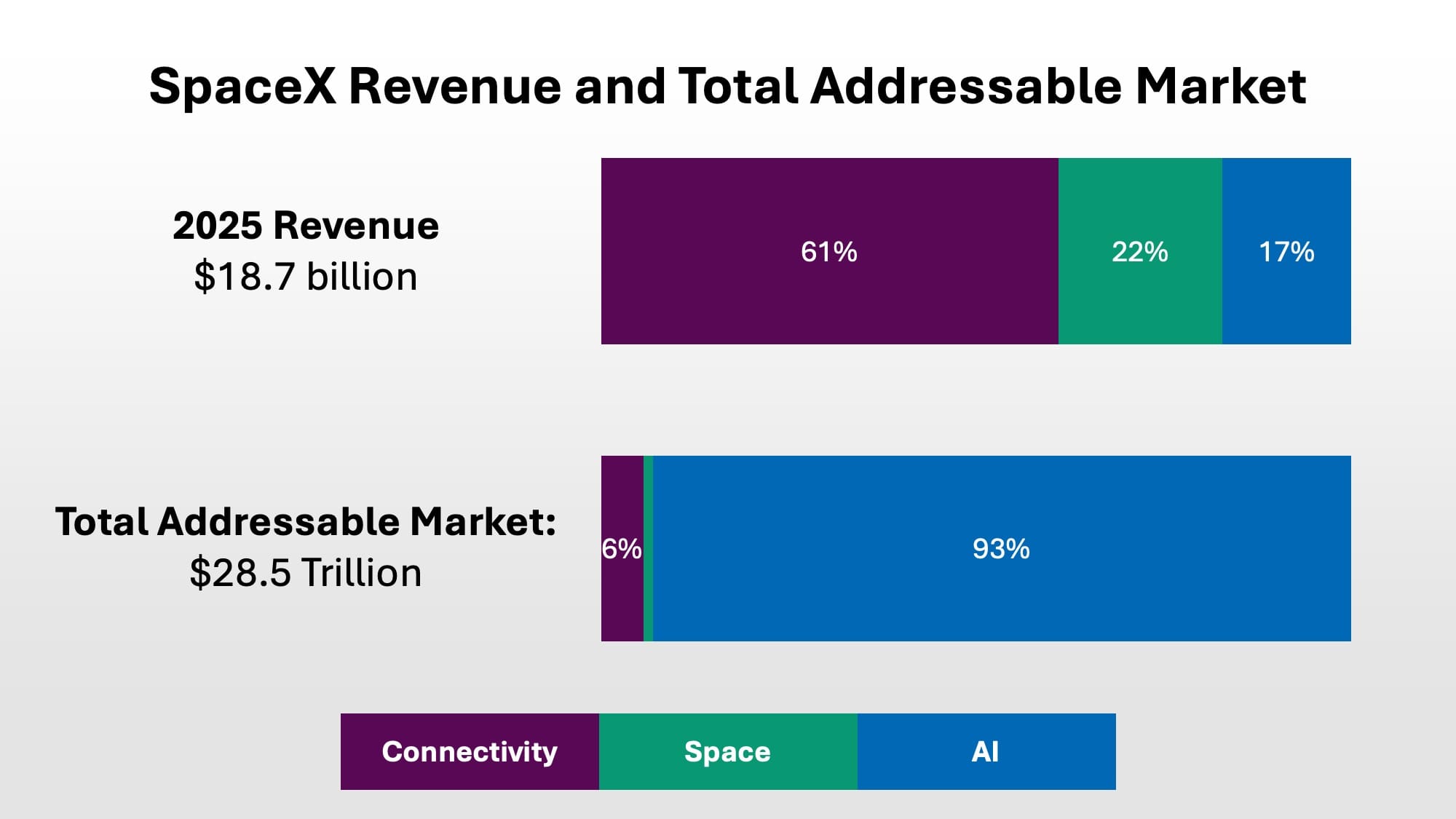
Of course it's the TAM (and $1 trillion revenue target) that's driving the valuation of SpaceX; the company is not getting its $1.8 trillion $2.1 trillion $2.5 trillion valuation from last year's revenue, especially since only the Connectivity (Starlink) business is currently profitable.
As for the AI business, most of the TAM is in Enterprise Applications, an area where the company currently does very little. NYU professor Aswath Damodaran, the so-called "Dean of Valuation" called the TAM figure a "hallucination", and suggested that Grok came up with the number.
To be fair, SpaceX has a very long growth runway and some distinct advantages. For instance the company cites its plans to launch data centres into space, which will have not have the same power and physical footprint constraints as terrestrial facilities. But of course the company will have to spend massively (Goldman Sachs is estimating more than $100 billion of negative free cash flow in 2029), and there's a wide range of potential outcomes. I certainly won't try to predict whether this turns out to be a good investment, but one thing is quite clear: SpaceX is yet another large bet on AI.
The Market As a Whole Has Become an AI Bet
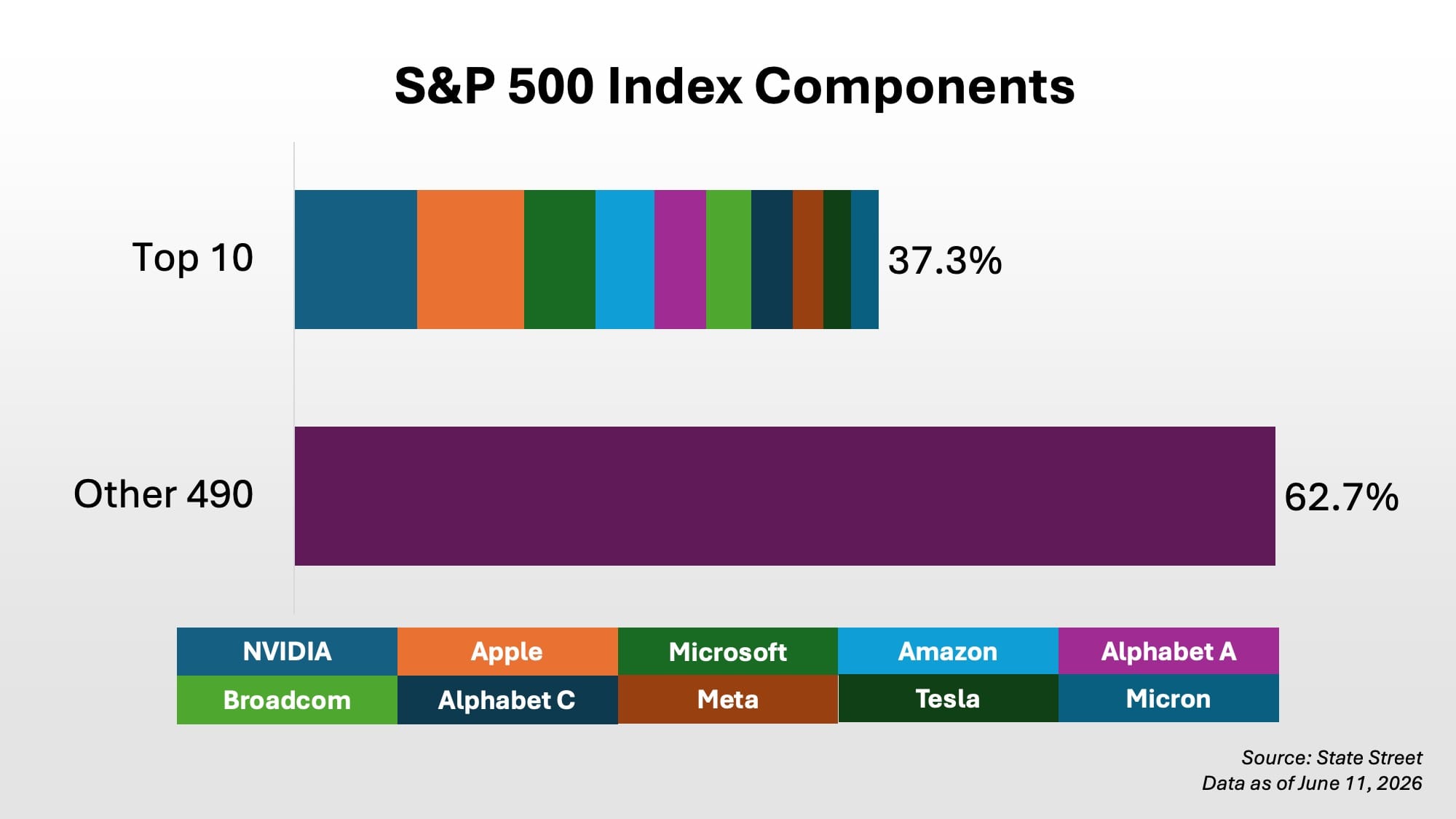
Much has been written about the strong performance of the U.S. market, in particular the large-cap tech stocks. But this has created an environment where the top ten stocks in the S&P 500 account for nearly 40% of the index. And these ten stocks are all quite related to each other; they are all tech or tech-adjacent companies, and they are all heavily involved in AI. So there's an argument that buying these ten stocks is akin to making s singular bet on the future of AI.
Even outside the top ten stocks, it's clear that AI is driving stock market returns. According to Goldman Sachs, the vast majority of S&P 500 EPS growth came from AI infrastructure firms and hyperscalers last year, and that trend is due to accelerate over the next two years. KKR had a similar finding, with the firm estimating that AI-related companies drove 60% of S&P 500 EPS growth in the most recent quarter.
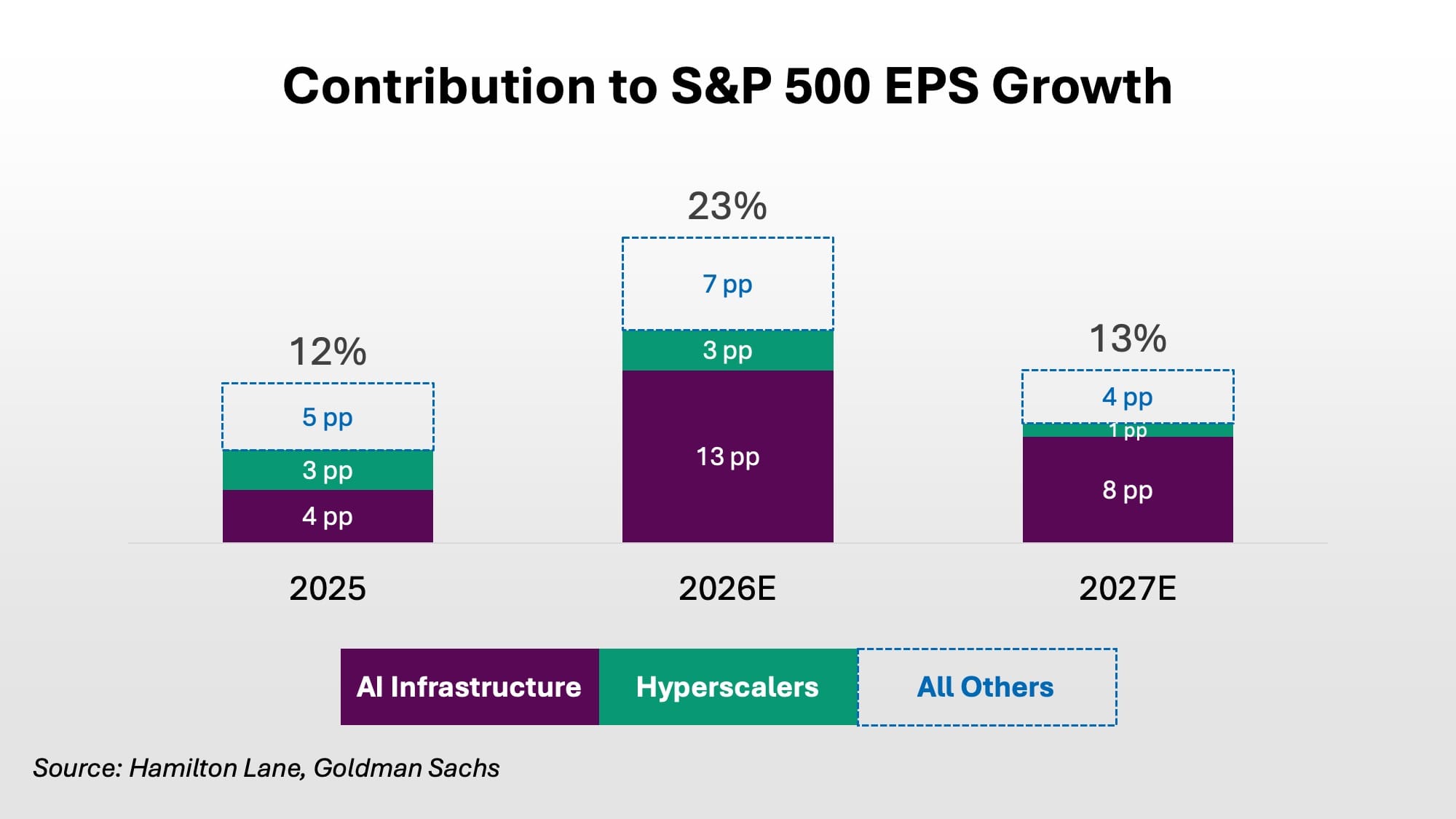
Even when looking at companies outside the tech sector, AI is becoming a meaningful contributor to productivity growth and earnings growth. So even the seven percentage point figure in the chart above, for "All Others" in 2026E, is largely being driven by AI. The same could be said for stocks outside of the United States. It's yet another reason why public equities have performed so well, despite the heightened geopolitical risks over the past 18 months.
And none of these numbers include SpaceX.
This Is Not a Sure Bet
The AI trade has certainly been a big winner thus far, but there are a number of ways it could go wrong. Below is a list of items that may be unlikely in the near term, but are still within the realm of possibility. And I would argue none of them are being priced into the stock market nowadays.
The war in Iran could drag on much longer than expected, and/or spread geographically, thus leading a much greater energy supply shock.The recently-announced ceasefire could fall apart.- Trump could start new trade wars (or intensify the existing ones).
- Related to the first two points, inflation could spiral out of control again, leading to another big increase in interest rates.
- Low consumer confidence could lead to weakening economic growth, or even civil unrest, particularly if AI leads to accelerating job losses.
- Local opposition to data centre construction could lead to reduced growth in the use of AI (part of the case for SpaceX's orbital data centres).
- Government regulation on AI could be much more stifling than predicted.
- Power could become even more difficult to source, thus inhibiting data centre construction (another part of the case for SpaceX's orbital data centres).
- Hostile action by China (for example another restriction on rare earth exports, or an invasion of Taiwan) could have a massive impact on the use of AI.
Are We Really Hinging Our Retirement To One Bet?
I am not making a call on SpaceX stock, nor the AI bet in general. Both have been massive winners thus far, and have created immense wealth for those with the foresight to bet on these companies.
But when looking ahead, the stock market is clearly not providing the same level of diversification it once did, and putting one's money entirely into the S&P 500 could now be thought of as one big bet. Many people are relying on this bet for their financial wellbeing, and for their sake I hope it works out.
That said, diversification is something I always highlight as a benefit of Private Markets. Put another way, I would argue that an investment portfolio with infrastructure assets, and loans, and buildings, in addition to ownership stakes in businesses, is better-diversified and more resilient than one entirely invested in this stock market.
This is why the stock market, particularly now that it includes SpaceX, is absolutely worth talking about in a newsletter entitled Beyond The Exchange.
Want to find out more?
Private markets are not for everyone, and come with a number of risks, such as higher illiquidity and less transparency.
However, many of the world’s leading institutions and wealthiest families put a big emphasis on private markets, and recently these strategies have become more available to individuals too. Drawing on my background as an analyst specializing in private markets, I help investors cut through the complexity and understand how to build portfolios incorporating these strategies.
To explore whether these strategies are suitable for you, please schedule a 30-minute virtual meeting below:

Email
|

Phone
|

LinkedIn
|

Apple
|

Spotify
|
Disclaimer
Benjamin Sinclair is a representative of Designed Securities Ltd. Designed Securities Ltd. is regulated by the Canadian Investment Regulatory Organization (ciro.ca) and is a Member of the Canadian Investor Protection Fund (cipf.ca). Investment products are provided by Designed Securities Ltd. and include, but are not limited to, mutual funds, stocks, and bonds. Benjamin Sinclair is registered to provide advice and solutions to clients residing in the province of Ontario. For more information, please see www.beyondtheexchange.ca/disclaimer/