

Good morning everyone, and Happy Tuesday Wednesday.
Today I’ll be boarding a plane to Vancouver for Designed’s annual conference. The theme this year revolves around AI and the future of financial advice, so there should be lots to learn. But this means I won’t have time to write a newsletter issue this week 😢. So I’m afraid the next one will come out in two weeks.
As for last week, it was relatively uneventful on the personal front. I did not attend any conferences, nor did I upload any new podcasts (although I hope to have more to announce on the podcast front). Nor did I have an affair with a Chinese spy. Or any spy. Or any person, just to be clear.
But without question, Jensen Huang’s infidelity was the story of the week in the investment world. And to me at least, it seems somewhat ridiculous that a Chinese spy can have such a large impact on the stock market as a whole. And this comes after a (very slight) unwinding of the AI trade after the U.S. midterm elections.
So with all that said, it’s time to take a closer look at the S&P 500 today, where it stands, and why it no longer feels like a true index.
Ben
Why the S&P 500 Doesn’t Feel Like a Real Index
The S&P 500 is by far the world’s most important stock market index. It’s the one that dominates the news cycle. It underpins the world’s three largest ETFs: VOO, IVV and SPY. And it’s the one that everyone compares their investment performance to (even when perhaps not appropriate).
It’s also been one of the world’s best-performing indices, driven by strong returns in the tech sector. Over the past 10 years, the index has appreciated by more than 13% per year. Including reinvested dividends, that number increases to more than 15%, good enough to quadruple your money over that time span.
It’s quite remarkable considering what’s happened in the past 10 years, including a global pandemic, a steep interest rate hiking cycle, a number of trade wars, and a number of actual wars.
But with all that said, there’s a very familiar question that pops up, one that financial advisors get all the time from prospective clients: “why don’t I just put all my money in the S&P?”.
Returns Driven by the Tech Sector
This should not be new to anyone. But ever since the financial crisis of 2008, technology stocks have driven the returns of the S&P 500. Over the past 10 years alone, the S&P technology sector has returned more than 700%, compared to 256% for the index as a whole, and only 166% for the S&P excluding technology.
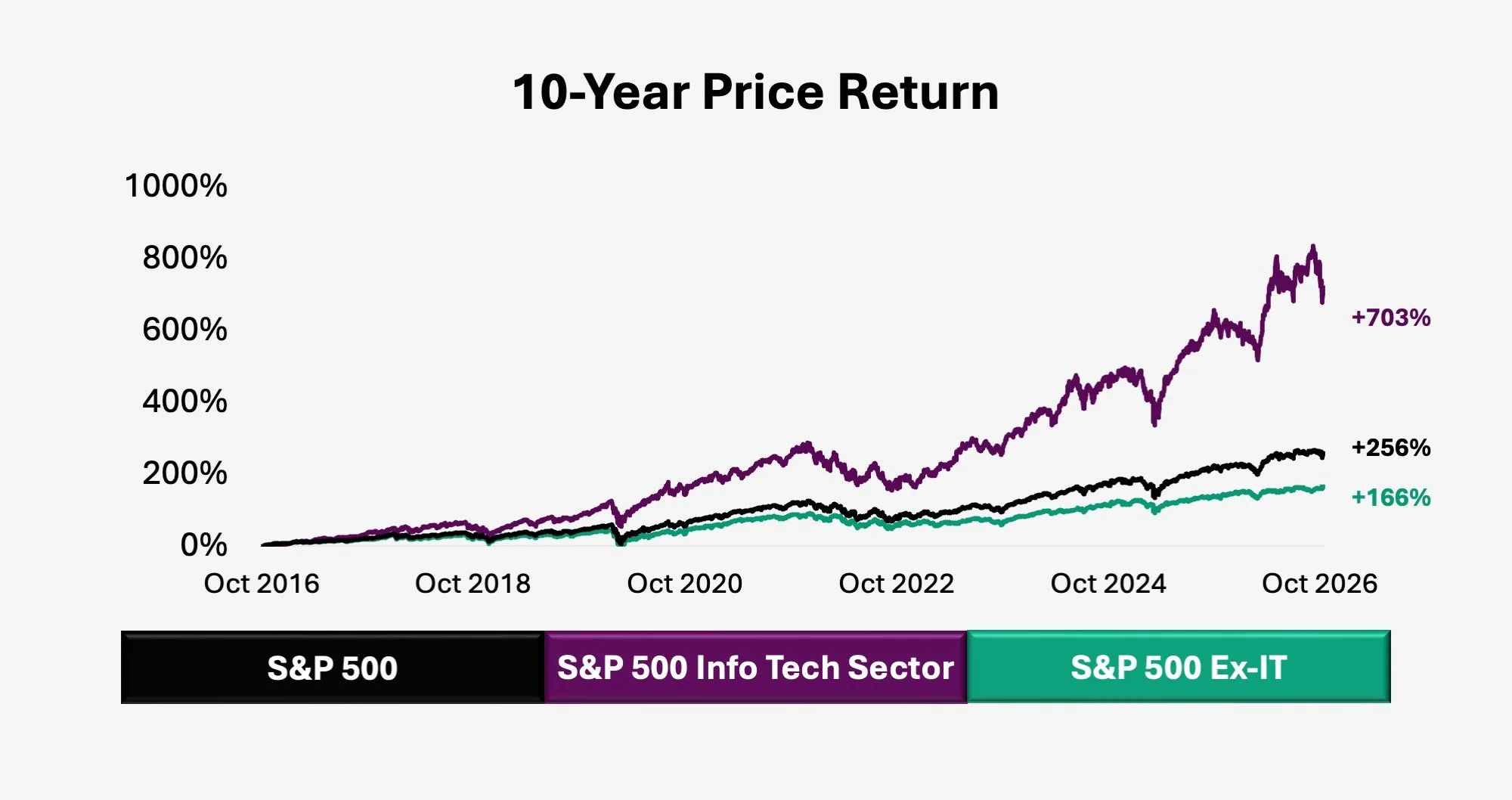
Source: S&P Global
Of course, the S&P 500 owes no one an apology for having a best-performing sector. Every index has one. But its market-cap-weighted structure can amplify the dominance of its biggest winners. As their share prices rise, so do their weights in the index. They then attract a larger share of new passive investment, while active managers face pressure to own them or risk falling behind their benchmark. That buying can create a self-reinforcing cycle.
The contrast with the equal-weighted S&P 500 is telling. It holds the same companies but gives each an equal allocation at each rebalance, rather than weighting them by market value. Its substantial underperformance relative to the standard S&P 500 over the past decade highlights just how much the largest companies have driven the index’s returns (although that pattern reversed this year with the Democrats’ win and the Chinese spy).
In fact the S&P Equal Weight chart looks very similar to the chart when excluding technology altogether. So by equal-weighting all the stocks in the S&P 500, the outperformance of technology over the past decade is practically nullified:
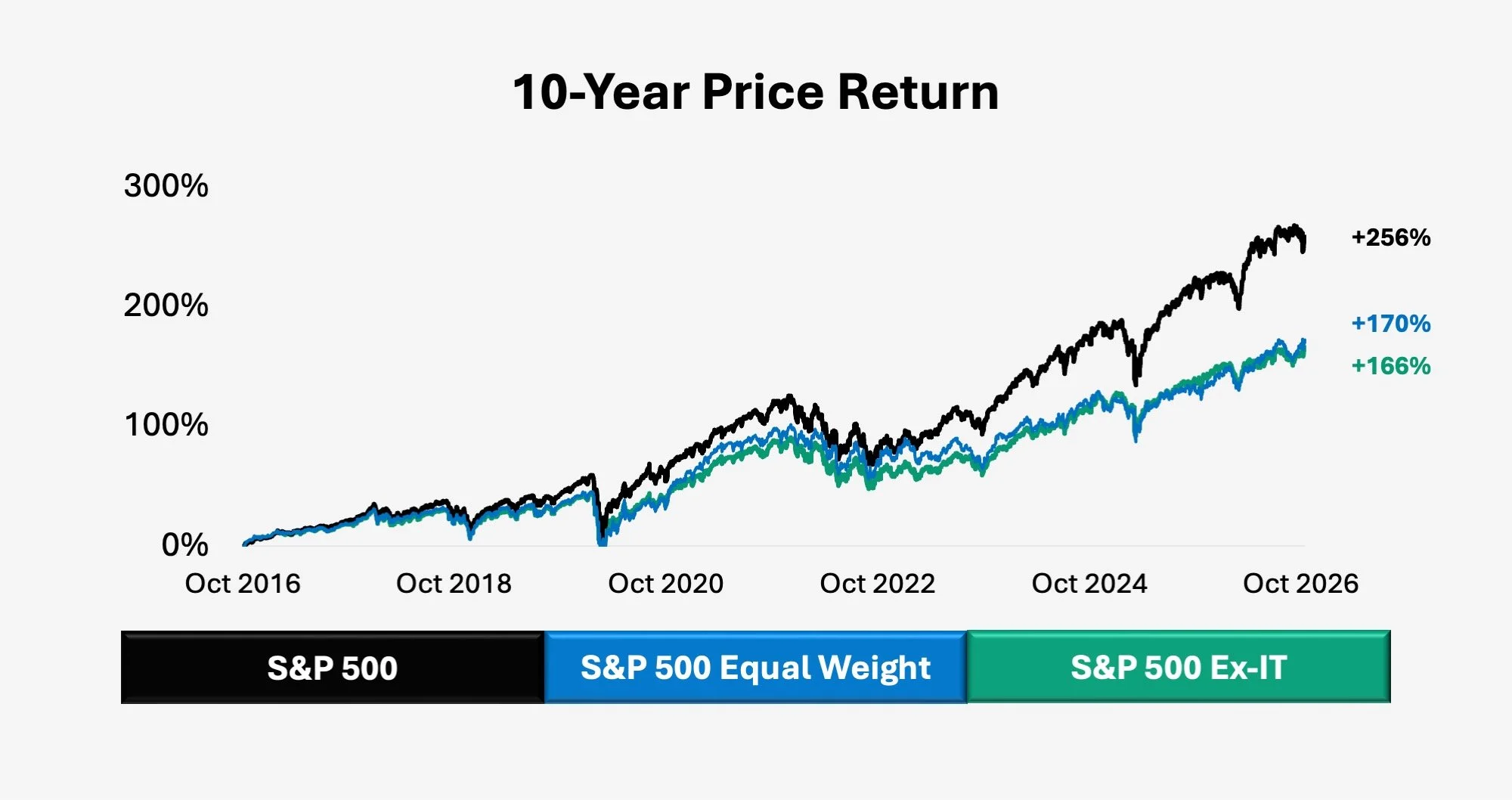
Source: S&P Global
An Overly Concentrated Index
The result of such outperformance is very predictable: large technology stocks dominate the index. Information technology accounts for 37% of the S&P 500, as do the top ten names, and both numbers are very high by historical standards.
Even when looking at the top five names, those stocks account for over a quarter of the S&P 500, and all five are broadly thought of as being technology companies.
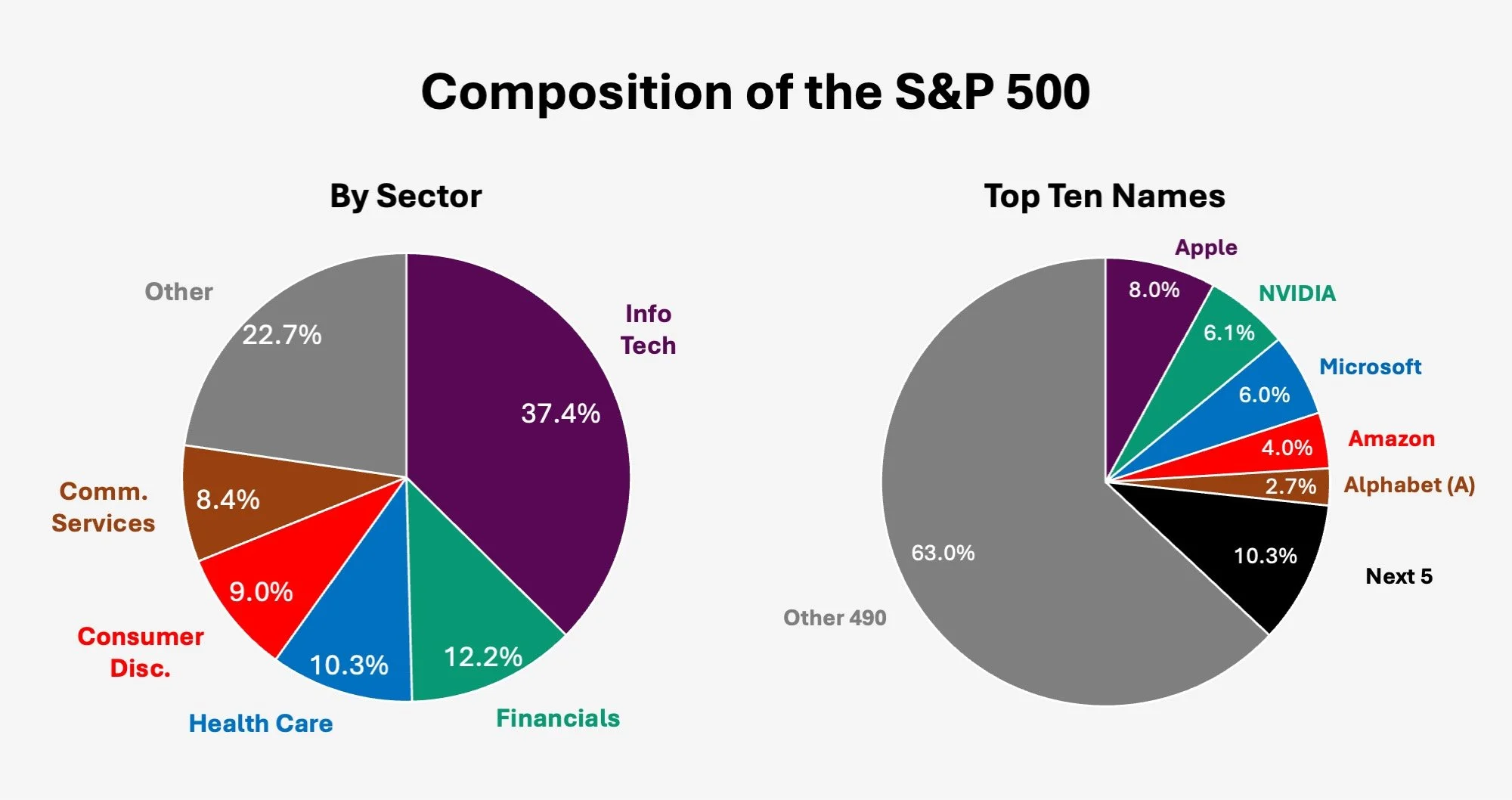
Source: S&P Global
Not Much Reprieve From Going International
While the S&P 500 index is a U.S. index, and the dominance of technology companies is largely a U.S. phenomenon, the story doesn’t get much different when looking at global indices.
The most popular and widely cited global index is the MSCI World. Yet due to the U.S.’s outperformance, and the fact that this is another market cap-weighted index, the United States accounts for over 70% of that index. Not coincidentally, information technology is again the largest sector, although thankfully the index is a little more broadly diversified than the S&P 500.
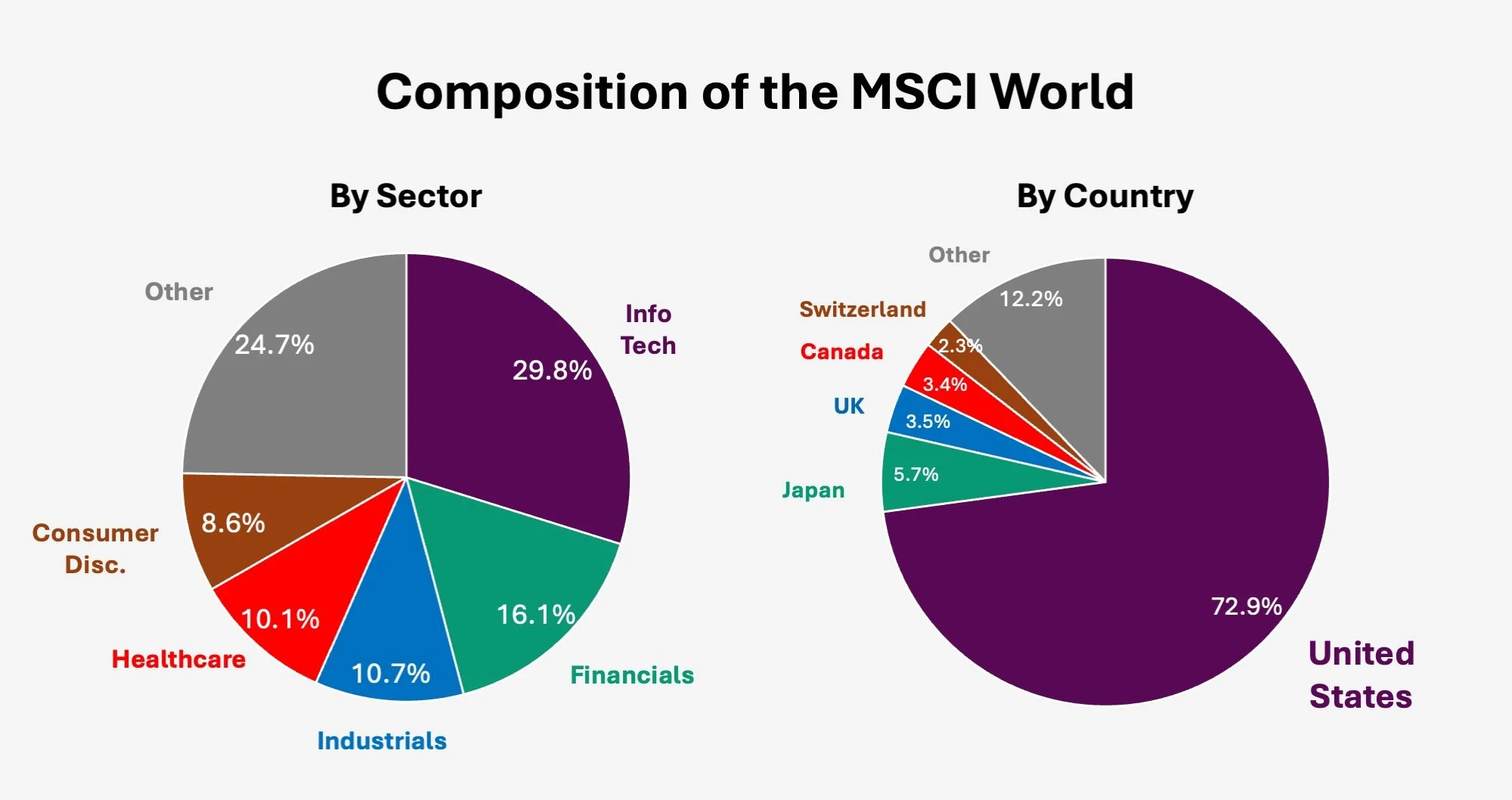
Source: MSCI
So What Should Investors Do?
If you’ve had the bulk of your money in the S&P 500 over the past 10-15 years, start by celebrating. It’s been a remarkable run, and many of those who’ve done even better have simply made a bigger bet on technology.
The next step is to make sure that winning bet hasn’t become too much of your portfolio. Investing globally can help, but simply switching to the MSCI World may not provide as much diversification as you’d expect, as we’ve just seen.
Active managers can also play a role, provided they offer something meaningfully different. Look for managers who aren’t replacing one big sector bet with another, or letting pressure to keep up with the S&P 500 dictate what they own. The trade-off is accepting that a genuinely diversified portfolio may have lagged the S&P 500 in recent years.
Private Markets can broaden the opportunity set too, particularly through exposure to Real Estate, Private Credit, and Infrastructure.
Most importantly, we need to stop treating the S&P 500 as the sole measure of investment success. The right yardstick should reflect what you own and risks you’re taking, not the overwhelming success of a few technology companies. And your expectations for future returns shouldn’t depend on a repeat of an exceptionally strong past.
None of this requires calling a bubble. It simply requires recognizing that a winning bet from the past isn’t necessarily the best bet to make in the future, and that success can be a reason to rebalance rather than double down. And if you ignore that advice, your portfolio may be more vulnerable to a Chinese spy than you’d like.
Want to find out more?
Private markets are not for everyone, and come with a number of risks, such as higher illiquidity and less transparency.
However, many of the world’s leading institutions and wealthiest families put a big emphasis on private markets, and recently these strategies have become more available to individuals too. Drawing on my background as an analyst specializing in private markets, I help investors cut through the complexity and understand how to build portfolios incorporating these strategies.
To explore whether these strategies are suitable for you, please schedule a 30-minute virtual meeting below:
Disclaimer
Benjamin Sinclair is a representative of Designed Securities Ltd. Designed Securities Ltd. is regulated by the Canadian Investment Regulatory Organization (ciro.ca) and is a Member of the Canadian Investor Protection Fund (cipf.ca). Investment products are provided by Designed Securities Ltd. and include, but are not limited to, mutual funds, stocks, and bonds. Benjamin Sinclair is registered to provide advice and solutions to clients residing in the province of Ontario. For more information, please see www.beyondtheexchange.ca/disclaimer/