

Good morning everyone, and Happy Tuesday.
Last week I attended a couple of great events , both on Wednesday. One was the Alts X Alts conference, which brought together a handful of Private Markets managers for some interesting panel discussions. The other one was put on by Blue Owl, a manager that I’ve always had a lot of respect for. The Blue Owl event also featured a special guest, NHL Hall of Fame defenceman Chris Pronger.

On the left, me with Chris Pronger. On the right, me with Vikram Rajagopalan, CEO of 2.0 Capital Partners, the organizer of the Alts X Alts conference series.
That said, the big news event last week was the so-called “Blue Tsunami”, in which Democrats did extraordinarily well at the midterm elections. And while this is not a political newsletter, there are certainly plenty of market implications, including for Private Markets.
So I’ll make sure to focus on the financial impacts, and not on my personal feelings towards the utterly humiliating ass kicking that Trump and his allies suffered.
Ben
The Market Fallout From the Blue Tsunami
Going into the midterm elections on Tuesday, the Democrats were expected to do well, the polls were in their favour, and they had the momentum. But the actual results were still much better for the Democrats than practically anyone predicted:
Democrats are projected to win about 260 seats in the House of Representatives (according to Kalshi), compared to 175 for Republicans. Only 218 are required for a majority.
Democrats have already won 54 Senate seats, with Kalshi predicting two more (97% likelihood in Alaska and 99% likelihood in Mississippi).
Texas delivered a double breakthrough: James Talarico won the Senate race, while Gina Hinojosa defeated three-term Republican Gov. Greg Abbott. Democrats had not won a Texas Senate election since 1988.
Five Republican-held governorships flipped: Georgia, Iowa, Ohio, Texas and Nevada. Democrats now hold a majority of governor’s offices for the first time since 2010, and 75% of the country is projected to have a Democratic governor.
At least five states moved from divided government to Democratic “trifectas”: Wisconsin, Michigan, Minnesota, Pennsylvania and Nevada.
As for the market reaction, there was a strong divide between the winners and losers the next day. The clearest losers fell into two camps: energy companies, and those involved in the data centre buildout. The list of winners was much longer, including large technology companies such as Apple, Alphabet, Microsoft and Amazon.
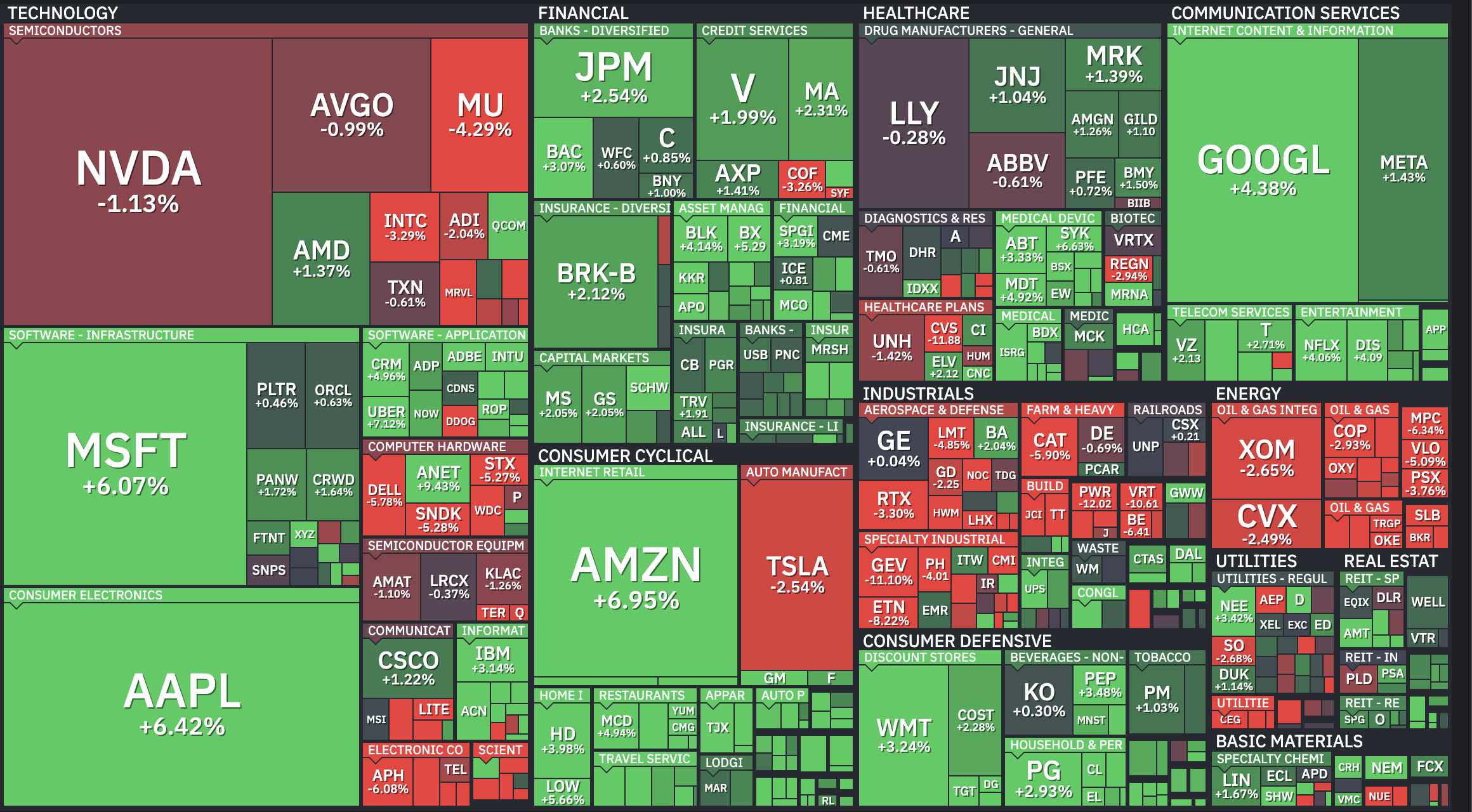
The one-day stock performance of each S&P 500 company following the midterm elections.
But then the markets had a terrible Thursday, indicating that investors have needed some time to digest the news. That being the case, some clear themes have emerged:
A slower data centre buildout, and the results in Texas are particularly impactful here. Governor-elect Gina Hinojosa has pledged to halt new data centre projects until the state legislature passes laws "to protect Texans, so that Texans have a seat at the table to decide if and how data centres come into our community." The outgoing governor, Greg Abbott had already slowed down new construction, but he’s always been much more in favour of data centre construction than his opponent. And Texas has become the epicentre of the data centre buildout.
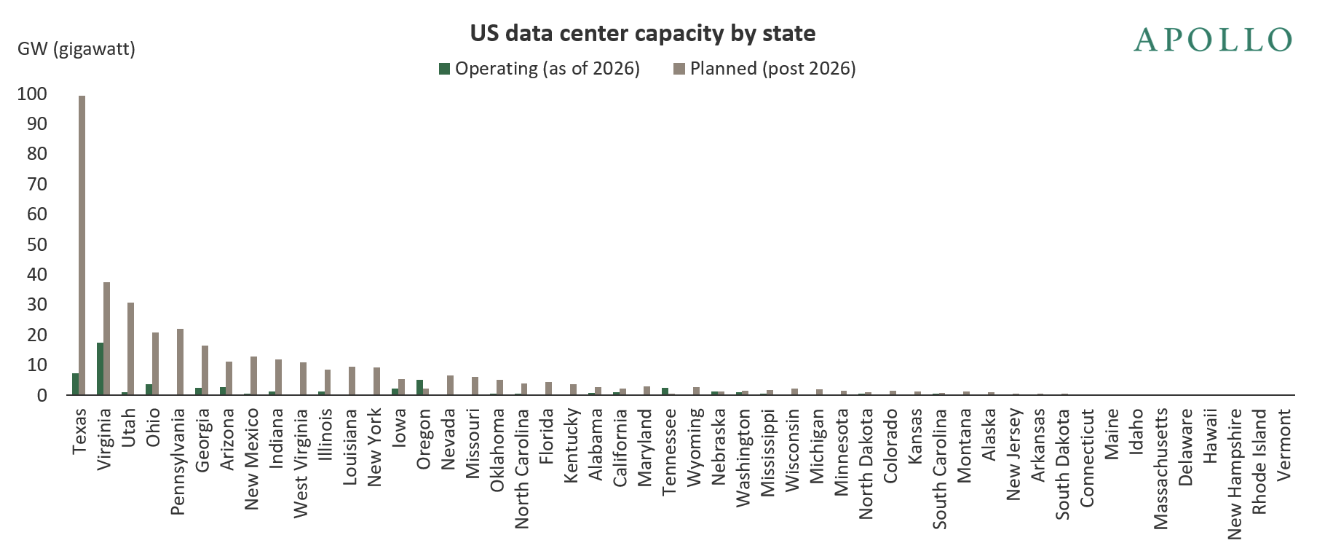
Source: Apollo
Curtailments on the Iran War, with Democrats controlling the purse strings in Congress. They can refuse additional appropriations, attach conditions to future spending, or enact an explicit prohibition on spending money for specified operations against Iran. There are limits to this newfound power, especially since some funds are already available to the Pentagon, and Trump can still veto any new legislation. Nevertheless, the selloff in oil & gas companies clearly showcased the market’s view of the election’s impact.
Limits on deficit spending. This may be counterintuitive, based on previous notions of the two parties. But “reduced deficit spending” was even highlighted by JPMorgan traders, as Democrats can block new rounds of fiscal stimulus and tax cuts. Democrats can also fight back against tariff wars, which could make for less inflation, especially if energy prices also fall with limits on the Iran War. Treasury yields fell as a result.
A Net Positive For Private Markets
When Donald Trump won the 2024 election, the alternative asset managers saw their stock prices spike upwards. Market participants foresaw a more business-friendly approach, a looser regulatory environment, corporate tax cuts, and lax antitrust enforcement. Republicans were also known to be friendlier towards the industry than Democrats:
“If you think about the bargain that was struck politically for the Biden presidency, going back to the early days of how he was elected, there was a bargain struck where the progressive wing of the Democratic Party, Bernie Sanders, Elizabeth Warren, were given control of the financial regulatory apparatus. Okay. I could not envision a more hostile environment to private capital than the last four years. Enough said.”
Apollo CEO Marc Rowan in December 2024
But then over the next two years, the alternative asset managers badly underperformed the market. Tariffs and geopolitical uncertainty were a headwind for transactions, and Private Equity companies continued having trouble selling their portfolio companies. The spike in oil prices was also unhelpful, as Private Equity companies are not especially known for investing in oil & gas.
The AI buildout has also presented challenges. Private Markets are heavily invested in enterprise software, both on the credit and the equity side, and many of these companies could be ripe for disruption. Even the private funds that own data centres have had to contend with the prospect of data centre overbuilding.
So with the political environment being flipped on its head, and Democrats scoring huge gains, the alternative asset manager stocks again had a great reaction. This would have been unthinkable two years earlier, especially with Bernie Sanders and Elizabeth Warren still holding their Senate seats.
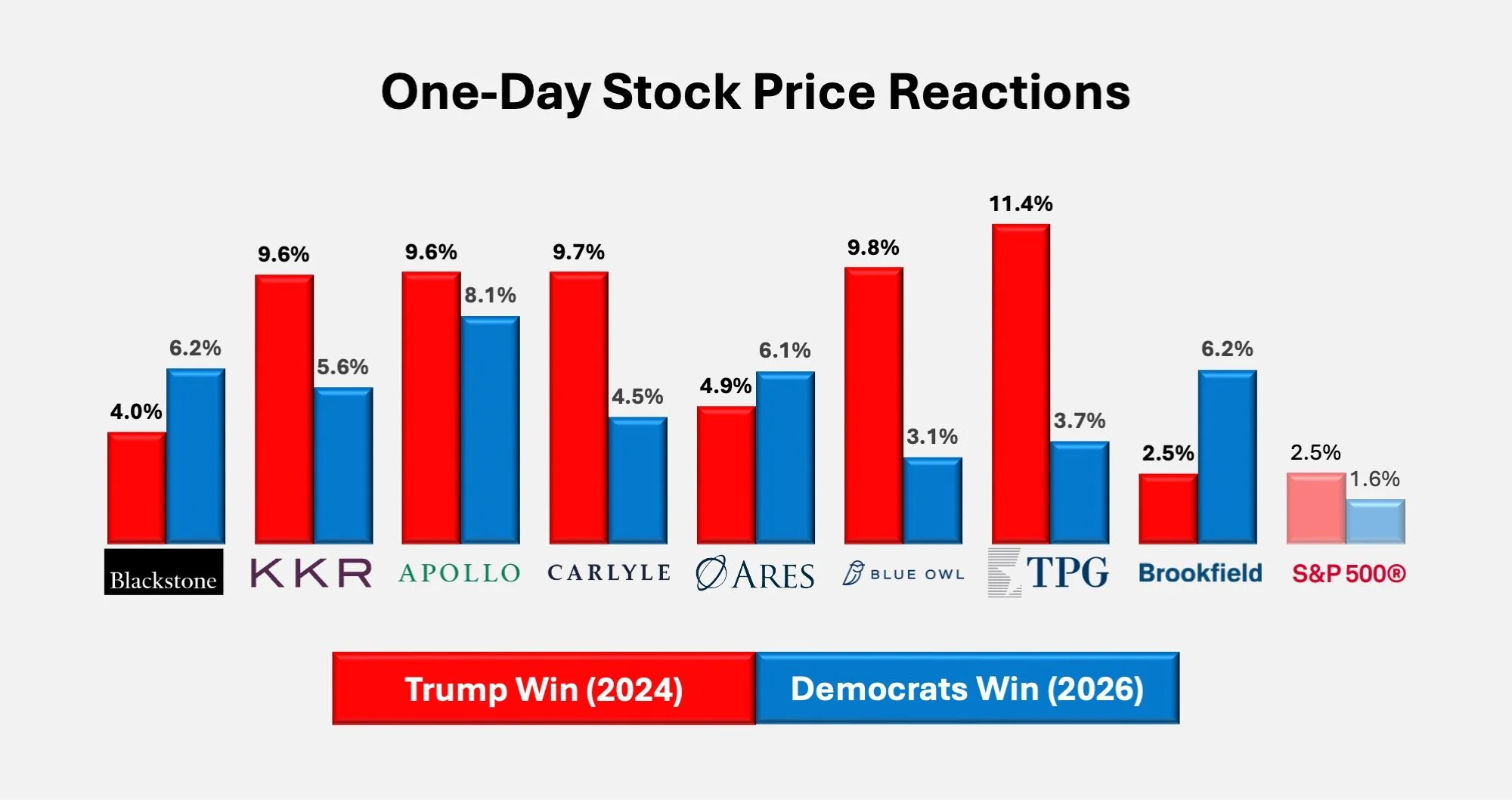
Why the Alternative Asset Manager Stocks Reacted Well to the Democrats’ Win
The reasons are very similar to the reasons the alternative asset managers have underperformed in the past two years, only in reverse:
A slower data centre buildout can be a positive for various strategies. For starters, this could slow the AI disruption risk for enterprise software companies. A construction slowdown could also help preserve the value of existing data centres that Private Markets firms own and finance.
Any deescalation in the Iran war will likely be helpful. While higher energy prices are a positive for oil & gas firms, Private Equity portfolio companies have had to contend with the negative effects, such as higher input costs and pressure on the U.S. consumer. If Democrats force Trumps hand into deescalating the war, and oil prices go down as a result, then Private Markets strategies could stand to benefit.
Lower inflation and lower interest rates would be a positive in various ways. For starters, assets could be valued using a lower discount rate, helping to boost valuations. Secondly, to the extent that variable-rate financing is used, interest burdens would decrease. This could be said for Private Equity, Private Infrastructure, and Private Real Estate strategies.
One more thing: a divided government can bring about stability, and we’ve seen this before. Divided governments tend to get very little done, which results in less policy uncertainty. On this note, any legislation tabled by more progressive Democrats to hurt the alternative asset managers will likely be blocked.
A Major Shift
In my opinion, too many people let their political views cloud their judgement when making on investment decisions. We see this type of thing in opinion surveys as well, with people being more optimistic about their country’s economic prospects when their party of choice is in power. As for me, I try to live by the saying “Politics and investing don’t mix.”
But there’s still no denying the Democrats’ sweeping victory has broad implications, both for public and private asset classes. Different industries will be affected in their own ways, and predicting how it will all shake out is a fool’s errand, but we’ve undoubtedly entered a new era in Washington.
Want to find out more?
Private markets are not for everyone, and come with a number of risks, such as higher illiquidity and less transparency.
However, many of the world’s leading institutions and wealthiest families put a big emphasis on private markets, and recently these strategies have become more available to individuals too. Drawing on my background as an analyst specializing in private markets, I help investors cut through the complexity and understand how to build portfolios incorporating these strategies.
To explore whether these strategies are suitable for you, please schedule a 30-minute virtual meeting below:
Disclaimer
Benjamin Sinclair is a representative of Designed Securities Ltd. Designed Securities Ltd. is regulated by the Canadian Investment Regulatory Organization (ciro.ca) and is a Member of the Canadian Investor Protection Fund (cipf.ca). Investment products are provided by Designed Securities Ltd. and include, but are not limited to, mutual funds, stocks, and bonds. Benjamin Sinclair is registered to provide advice and solutions to clients residing in the province of Ontario. For more information, please see www.beyondtheexchange.ca/disclaimer/