

Good morning everyone, and Happy Tuesday.
A couple of updates from last week. First of all, I attended the Legacy Exchange event hosted by the Burlington Community Foundation (BCF) on Tuesday. For those of you unaware, I have joined a committee at the BCF focusing on impact investing, and look forward to working with the organization in the years ahead. The Legacy Exchange event helped showcase a number of local non-profits, and also featured some good speeches, panels, and breakout sessions.

On the left, me with Paul Nazareth, who providees consulting services to charities. On the right, a panel discussion of local business owners hosted by BCF CEO Megan Tregunno.
Secondly, I recorded episode 16 of the podcast on Friday, and this one will have a bit of a different flavour. The interviewee, Afshan Butt of Wealthverse, is a financial planning specialist, and we talked about some of the intricacies of Private Markets in a financial plan (among other topics). It was one of the more interesting conversations I’ve had for the podcast, and the full episode should be released soon.
As for this week’s newsletter, Europe has been coming into sharper focus over the past 18 months, mainly due to geopolitical tensions with the United States. The continent has often been seen as a laggard when it comes to innovation, economic growth, and investment opportunities, but the current environment is bringing about a lot of changes. Europe was also a big part of my podcast interview with Ross Butler.
So it’s certainly a topic worth discussing, and of course there’s a Private Markets angle to the story. So I hope you enjoy it.
Ben
Europe’s Challenges and Opportunities
Europe rarely gets a glowing review in the finance and investment community. Critics point to high taxes, red tape, and a patchwork of economies, languages, and legal systems that make it tough for businesses to scale. The prevailing view is that these barriers weigh on growth, limit investment returns, and hinder the emergence of world-class companies.
Europe does have other factors working in its favour, but there’s no denying the continent can be doing more to progress economically. Most notably, former ECB Chairman and Italian Prime Minister Mario Draghi commissioned a report in 2024, which included some very striking findings:
EU companies spend €270 billion less on R&D than their U.S. counterparts, and this spending is led by the relatively sluggish automotive sector.
Between 2008 and 2021, 30% of unicorns founded in Europe moved their headquarters elsewhere, with the vast majority of these companies moving to the U.S.
EU companies pay 2-3 times as much for electricity as American companies, and 4-5 times as much for natural gas.
More than half of SMEs in Europe flag regulatory obstacles and the administrative burden as their greatest challenge.
EU household wealth has grown by only a third as much as American household wealth since 2009.
Part of the issues are structural. With so many countries, markets and languages, it will always be harder to coordinate economic policy than in the United States.
But there’s a cultural issue too, with less desire for risk taking. Whether that’s a company deciding not to spend so much on R&D, or households investing less of their savings in the stock market, or governments failing to pass reforms, Europe is too often known as a place where the status quo prevails.
As a result of all this, Europe’s economic growth has been underwhelming. In 2006, the EU economy was 11% larger than the USA’s. Fast forward to 2026, and the EU’s forecasted GDP is 29% smaller than the USA’s.
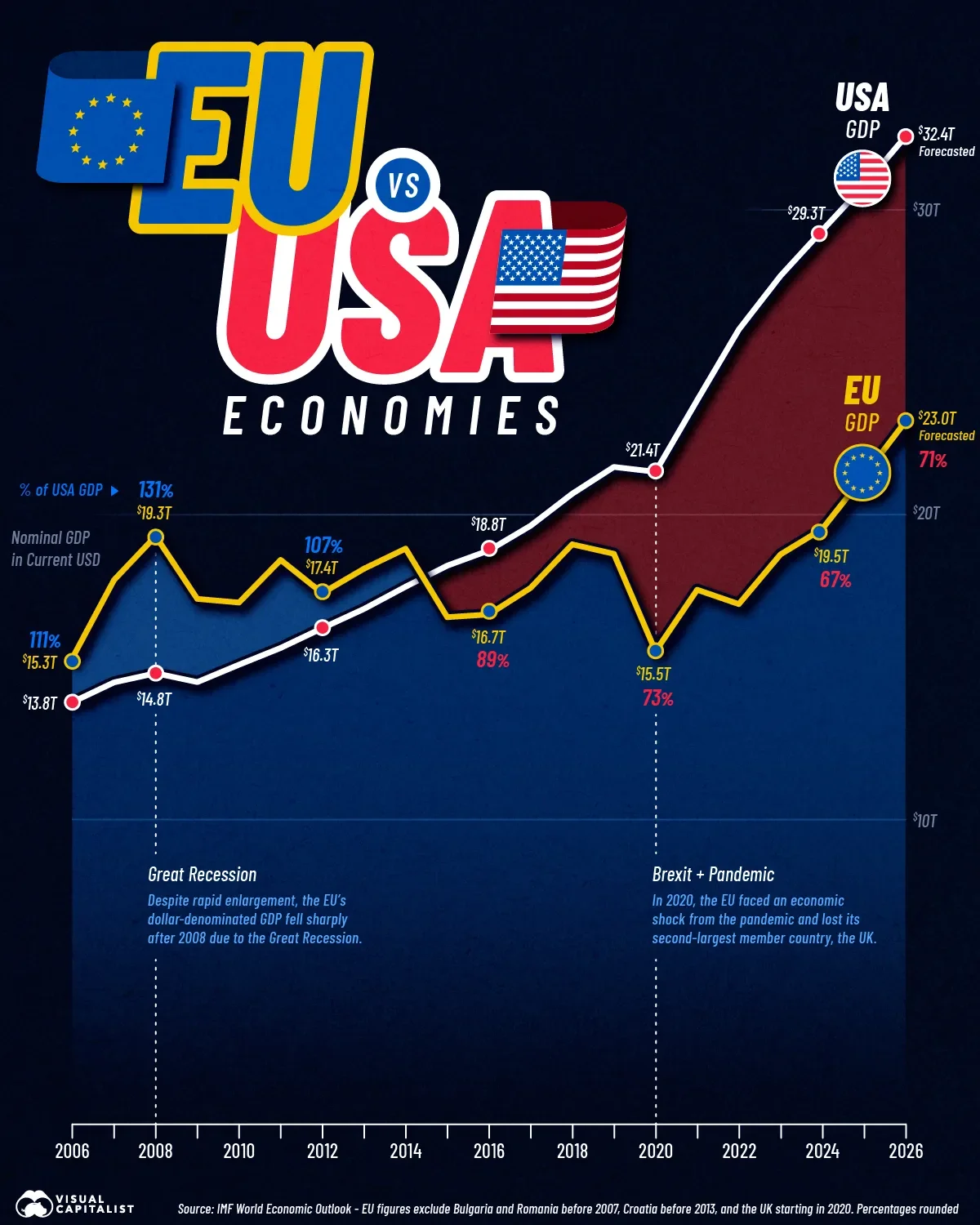
Source: Visual Capitalist
Things May Be Changing
There’s an old saying, “never waste a crisis” … and Europe is certainly facing its share of challenges, especially since January 20th, 2025.
With Trump’s actions, there has been heightened focus on Europe’s ability to withstand geopolitical turmoil. And in order to improve Europe’s position, that means improving economic competitiveness. Some of the steps Europe has taken include:
Reducing red tape: the EU adopted legislation narrowing corporate sustainability reporting and due diligence requirements.
Infrastructure investment: Germany has created a new fiscal framework, creating a €500 billion investment fund outside its regular fiscal framework.
Energy transition: The EU Commission launched the Clean Industrial Deal and Affordable Energy Action Plan in February 2025, targeting electricity costs, grid connections, electrification, permitting, and clean manufacturing.
Capital Markets: The EU has advanced its Savings and Investments Union agenda.
Competitiveness: In January 2025, the Commission introduced its Competitiveness Compass, explicitly based on Draghi’s recommendations.
Time will tell whether these efforts bear fruit, and history does not offer many reasons for optimism. But there’s clearly higher urgency than in years past.
The Investment Opportunity
It should surprise no one that European equities trade at a discount to their U.S. counterparts. Part of the gap is due to mix, with the S&P 500 having a much larger tilt towards higher-growth tech companies.
But the discount also reflects broader investor attitudes towards the continent. And with Europeans allocating less of their savings to the stock market, domestic equities have a smaller base of local investor demand.
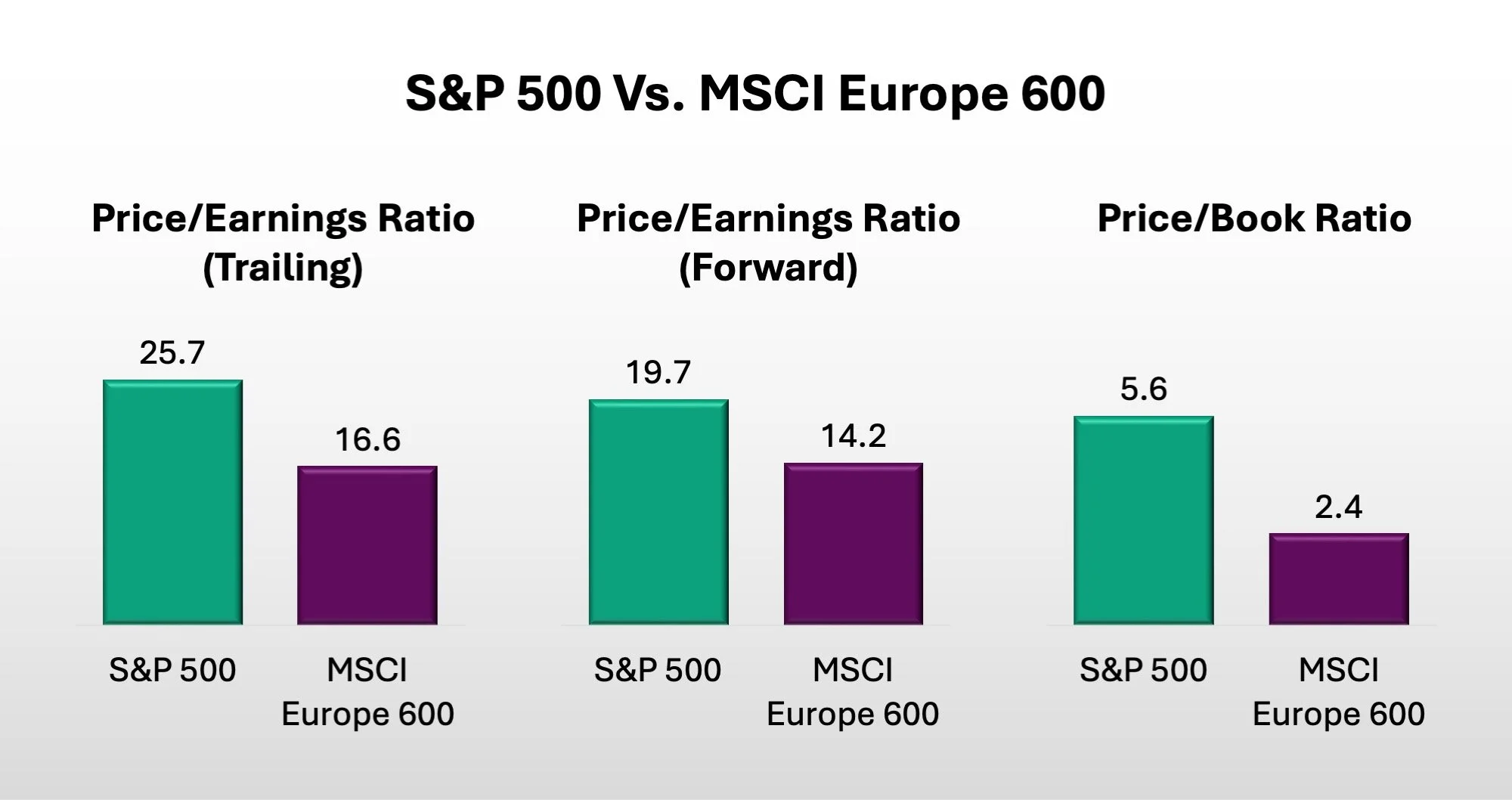
Source: S&P Global, MSCI
Of course European equities trade at a discount for a reason, and investors looking to take advantage of cheap prices in Europe have had plenty of disappointments over the past 30 years. The protests in France offer the most recent example of Europe’s vulnerabilities.
But if Europe is able to improve its economic competitiveness, and create an environment where companies can truly thrive, then these price anomalies could finally prove to be a golden opportunity for investors, whether that be in public or private markets.
And the opportunity looks especially appealing in Private Markets.
The Opportunity in Private Markets
A common criticism of Private Markets is that too many managers are chasing too few deals, making investment opportunities less attractive than when the market was smaller and less crowded. There’s a lot of legitimacy to that claim in the United States, depending on the strategy.
But Private Markets is much less penetrated in Europe. Just as an example, in a Private Equity International ranking of the world’s largest PE managers last year, 37 of the top 50 were located in the United States. The UK had six. And Continental Europe had only 4: EQT (Sweden), CVC (Luxembourg), Partners Group (Switzerland), and Ardian (France).
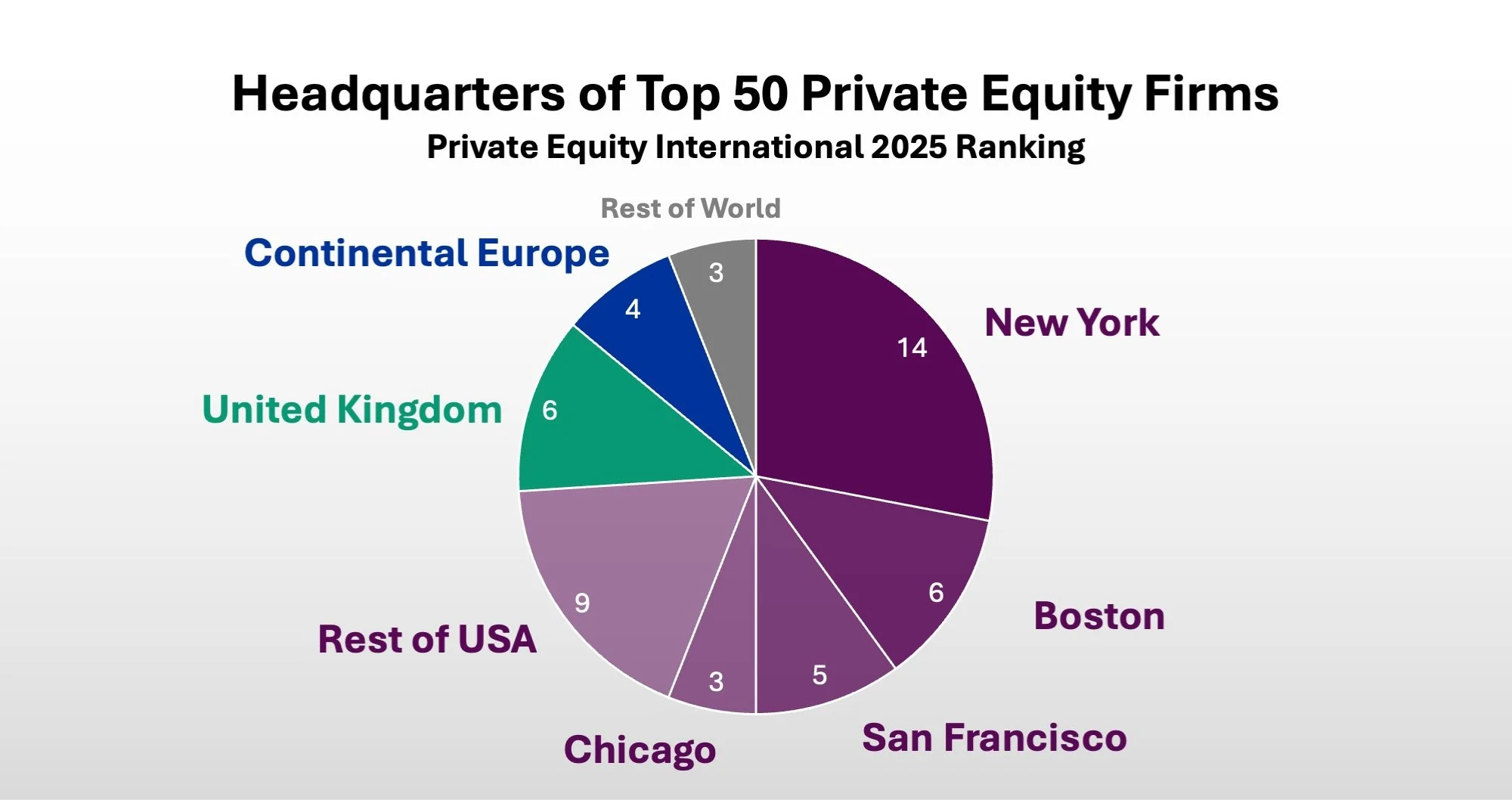
Source: Private Equity International
It’s a similar story in Private Credit. In the United States, Private Credit has already come a long way, and there are numerous anecdotes of competitive auctions, spread compression, and loose documentation. In Europe, debt financing is still largely controlled by the banks.
In this environment, Private Market deals can be more easily won through relationships and local knowledge, rather than competitive auctions. It’s a dynamic reminiscent of the U.S. Private Markets landscape years ago, and one that should create opportunities for attractive risk-adjusted returns.
For individual investors, Private Markets could therefore offer the best route to international diversification. Investing directly in European equities can be tricky, with information gaps, language barriers, and the practical hurdles of trading on foreign exchanges. A Private Markets fund can put those responsibilities in the hands of managers with local expertise.
A few Private Equity and Infrastructure funds available to Canadian investors already have substantial European exposure. I’m not aware of a dedicated European Private Markets fund available to Canadian individuals yet, but that could change. If it does, it will be worth a close look, especially if Europe takes the steps needed to reach its full economic potential.
Want to find out more?
Private markets are not for everyone, and come with a number of risks, such as higher illiquidity and less transparency.
However, many of the world’s leading institutions and wealthiest families put a big emphasis on private markets, and recently these strategies have become more available to individuals too. Drawing on my background as an analyst specializing in private markets, I help investors cut through the complexity and understand how to build portfolios incorporating these strategies.
To explore whether these strategies are suitable for you, please schedule a 30-minute virtual meeting below:
Disclaimer
Benjamin Sinclair is a representative of Designed Securities Ltd. Designed Securities Ltd. is regulated by the Canadian Investment Regulatory Organization (ciro.ca) and is a Member of the Canadian Investor Protection Fund (cipf.ca). Investment products are provided by Designed Securities Ltd. and include, but are not limited to, mutual funds, stocks, and bonds. Benjamin Sinclair is registered to provide advice and solutions to clients residing in the province of Ontario. For more information, please see www.beyondtheexchange.ca/disclaimer/