
BTE Newsletter #46: The Plan To Bring $1 Trillion in Investment Dollars to Canada

Good morning everyone, and Happy Tuesday once again. I hope you had a better weekend than I did watching the Ravens game.
Meanwhile, a couple of updates on the podcast front. I appeared on the Fund Shack podcast with Ross Butler, where we talked about the evolution of Private Markets for individual investors, and what the future holds. This podcast has been in existence since 2019, and is one of the most insightful in its space. I'd highly recommend a follow on Spotify or Apple. In the meantime, my interview is also on YouTube:
Even better, Ross agreed to appear on the Beyond the Exchange podcast as well, and we recorded the episode on Friday. That will be episode 15, and should be available in the coming weeks.
Ben
The Plan To Boost Investment In Canada
Canada has many ingredients that should lead to heavy foreign investment, including political stability, rule of law, an educated labour force, and abundant natural resources. With the increased prominence of data centres, Canada's cold weather and abundant land are also advantages. Yet Canada has often struggled to translate those advantages into larger foreign investment.
Now with Mark Carney a year and a half into his term as Prime Minister, and trade tensions with the U.S. at fever pitch, he hosted Canada's first ever Investment Summit. He's seeking $1 trillion in new investment capital in Canada over the next 5 years, including $500 billion in new private sector capital.
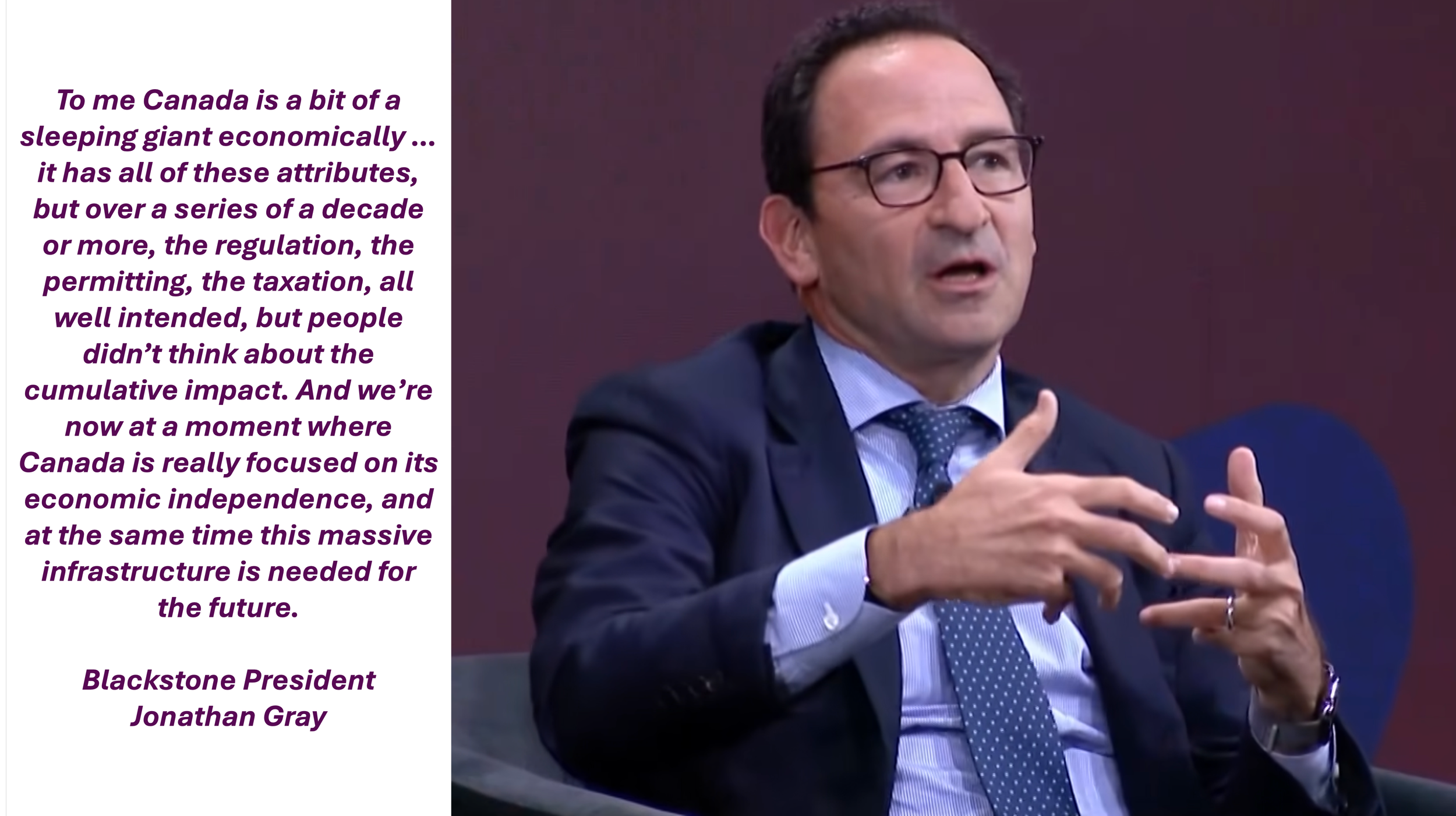
At the Summit, Blackstone CEO Jonathan Gray made the case that Canada has plenty of potential, but unfortunately has gotten in its own way:
In an interview with Bloomberg at the Summit, Mr. Carney addressed the trillion-dollar question: why has Canada failed to attract more foreign investment? He pointed to three factors, two of which overlapped with Mr. Gray's comments:
1. "Some major pools of capital have allocated to America, if I can put it that way, so U.S. and Canada lumped together, and they end up overweight the U.S. and underweight Canada."
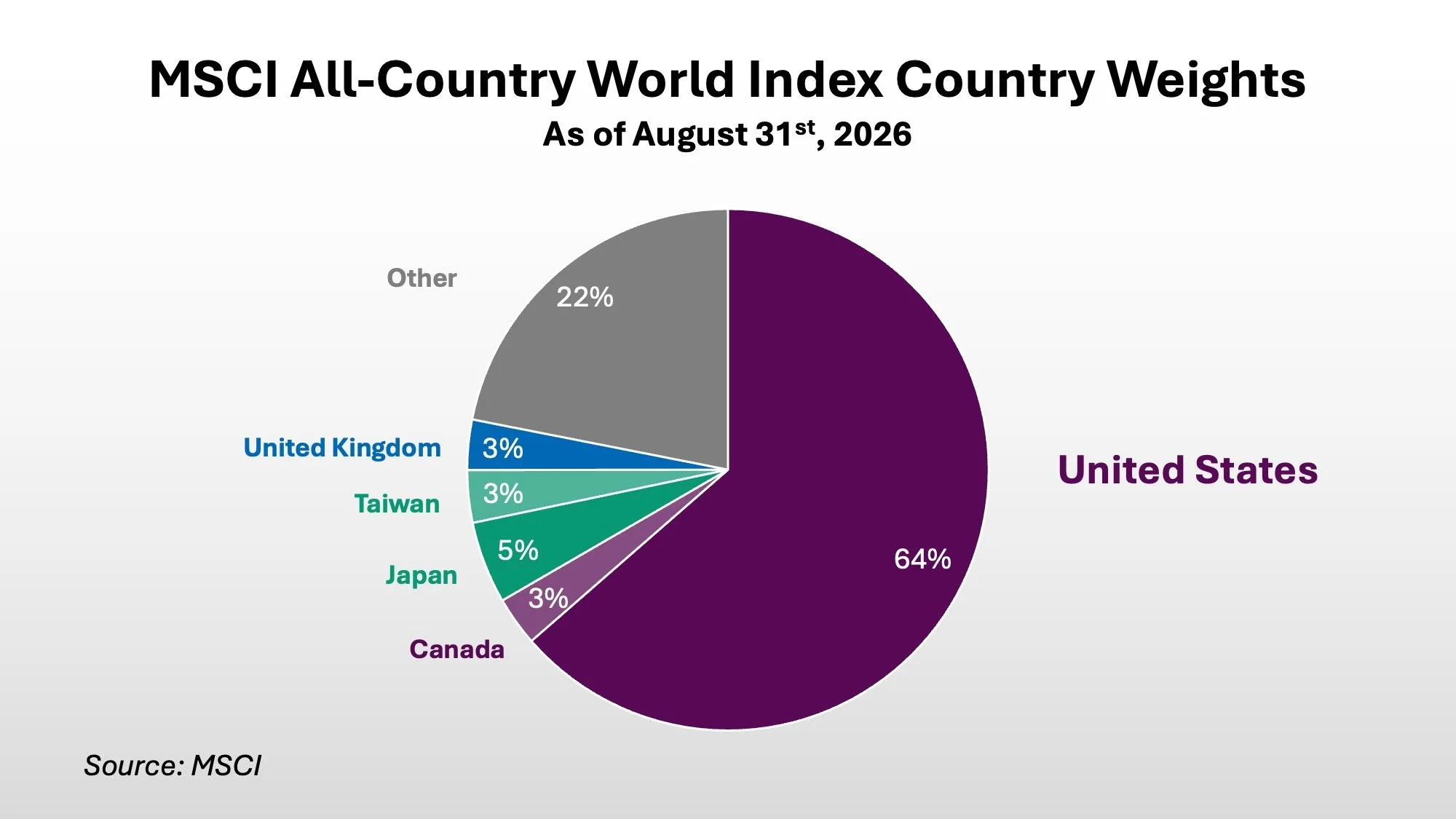
This is a natural way for international investors to approach the continent, especially in a more integrated global economy. If one looks at the public markets, the United States already accounts for a majority of the MSCI All-Country World Index. If an investment strategy is being measured against that benchmark, it's easy to see how Canada could be overlooked.
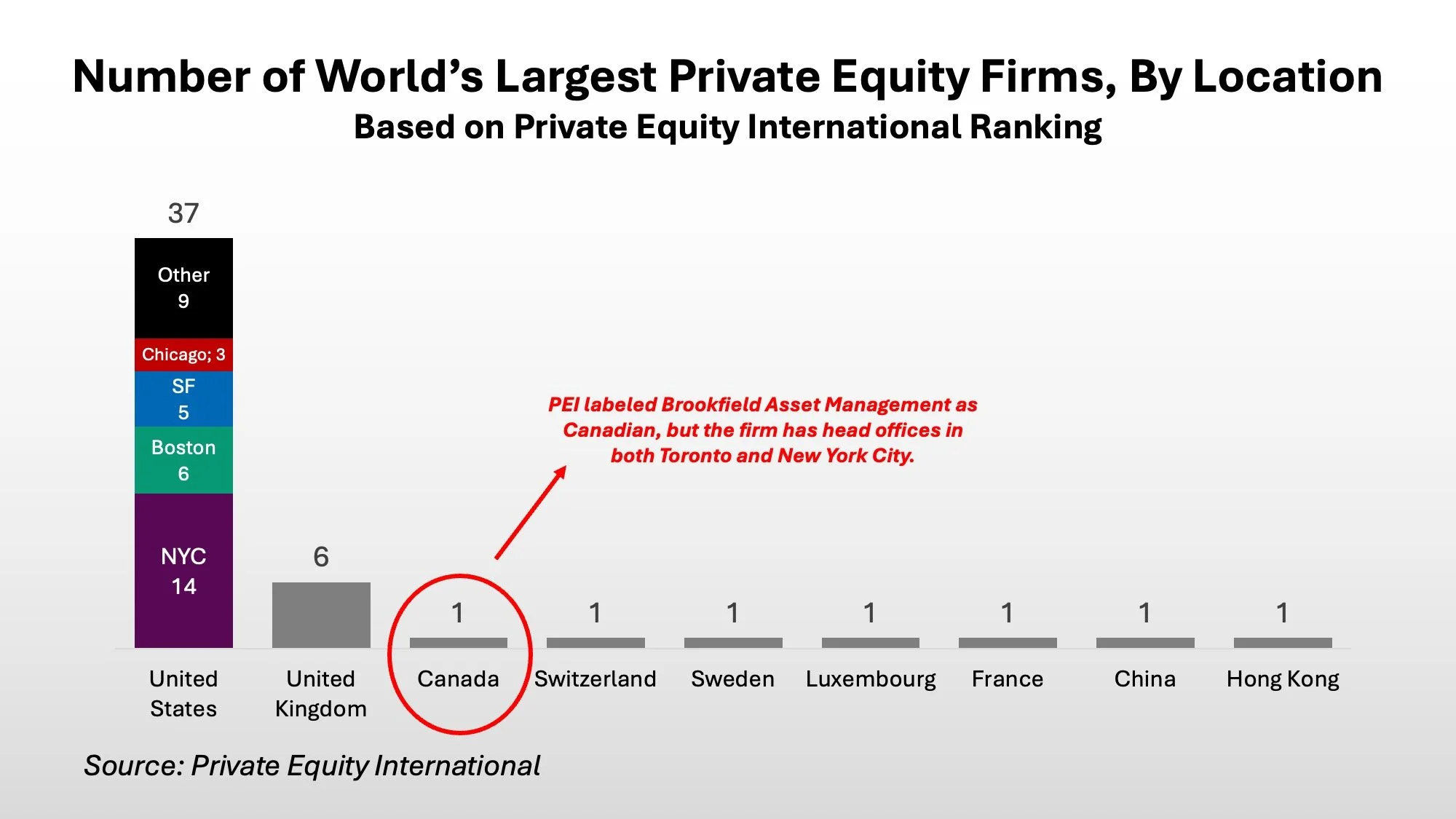
When looking at Private Markets, the picture is even more skewed. Strategies such as Private Equity are much more developed in the United States, and most of the world's largest Private Markets firms are based south of the border.
But nowadays it has become much easier to distinguish between Canada and the United States, and politics could drive more investment into Canada.
2. "We've been slow in moving on a series of areas with respect to regulatory approvals and other factors."
On this topic, Mr. Carney brought up the One Canadian Economy Act, including the Building Canada Act, which intends to spped up regulatory approvals and reduce interprovincial trade barriers. He also said the government is going to "double down" on these types of initiatives.
3. "The third issue is around the overall tax competitiveness..."
Again Carney pointed to legislation under his government, in particular the 2025 budget, which made certain types of capital investment deductible much sooner.
The Role of Private Markets
While on stage, Mr. Gray also made some interesting points about the role of Private Markets in Canada's buildout:
“Of course you need Private Capital, because if you're digging for minerals, or doing a 4-year LNG pipeline project, these are things that are harder in the public markets, they're harder on the equity side, they're harder to finance, because they're not cash flowing. Now, once they're up and stabilized, that's something different.”
He's not wrong. Public companies can only make so many short-term sacrifices for long-term benefits while being influenced by the quarterly earnings cycle. Likewise, banks are hamstrung by regulatory constraints, rigid frameworks, and a risk-off mindset. This makes it very difficult to finance projects that aren't producing cash flows right away, although there's tremendous need for longer-term projects.
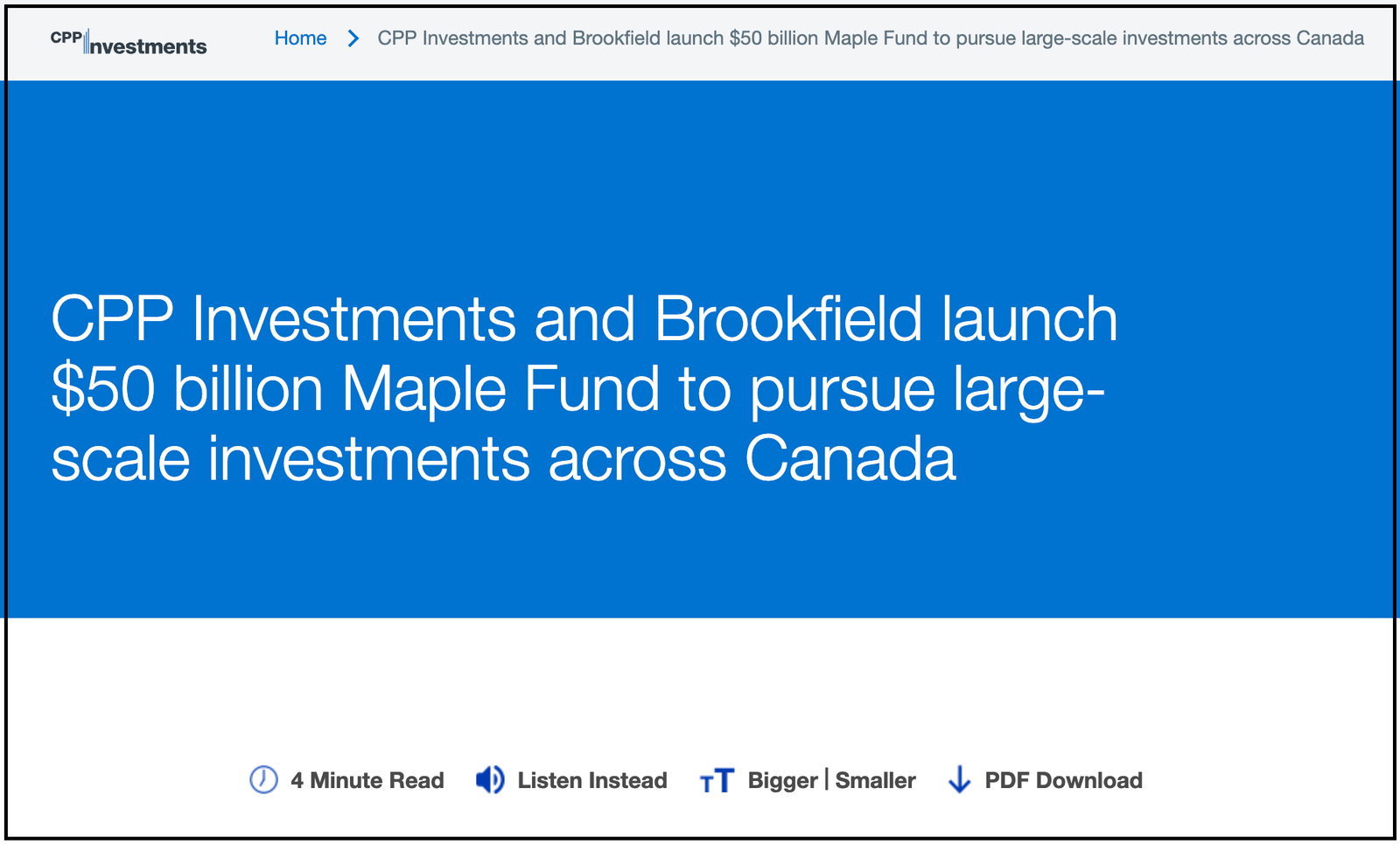
That being the case, there was a positive development announced last week: Brookfield Asset Management and CPP Investments will team up 50/50 on a so-called Maple Fund, for up to $50 billion of equity capital over 5 years. These are the ideal partners, given their ability to invest for the long term and their expertise in infrastructure investments. But for Canada to get to $1 trillion, many more such announcements must follow.
Source: CPP Investments
For individual investors, this does not signal the arrival of an Evergreen Canadian Infrastructure fund. The key constraint is deal flow, since Evergreen vehicles need a steady pipeline of investable assets to manage subscriptions and redemptions effectively. Without sufficient transaction volume, maintaining that balance can be difficult.
However, if Mr. Carney succeeds in making a more compelling investment case for Canada, we could see a larger share of Canadian infrastructure assets included in existing Evergreen Infrastructure funds. And this could make up a meaningfully portion of the $1 trillion target. Time will tell.
Will Politics Be a Problem?
It very well could be, in a number of ways. Foreign investment has always drawn been a contentious issue, and not just in Canada, as many people see it as corporate greed taking priority over local needs. The current animosity with the U.S. undoubtedly makes those feelings stronger. At the Investment Summit, over 1,000 protesters gathered in Toronto on Monday last week.

Source: Blackstone Private Credit Fund 10-K
There may also be additional wrinkles for the CPP/Brookfield deal, with Mark Carney having worked at Brookfield previously, and CPP being Canada's largest public pension.
Suppose that Brookfield and CPP make an investment into Toronto's Pearson Airport, and returns are particularly strong. Will the public view this as Mark Carney's former employer fleecing the public? Or what if returns from that same investment are weak? Will the public view this as CPP being under undue political influence?
Recall there was already some heated political debate when the Senate finance committee chair suggested public pension funds should invest more in Canada. The counter to that was pensions have a duty to their members, and should not be pushed around by politicians with different motives.
Then of course CPP itself had its own mini-controversy surrounding weak returns and excessive compensation not too long ago. More weak returns on Canada-first projects could spark further backlash. In other words, there could be a negative reaction if CPP's returns are too strong or if they're too weak.
Conclusion: "Fortune Favours the Bold"
Whether or not this $1 trillion goal is reached, it's clear that Canada needs to be intentional about attracting more foreign investment, even if there will be political backlash in certain cases.
It's also clear that Private Markets will be a big part of the investment dollars attracted, whether or not that number reaches $1 trillion. And this includes retail capital in Evergreen funds.
It's been said that Canada only acts on these types of initiatives "when it has to." If this is yet another example, then so be it.
Want to find out more?
Private markets are not for everyone, and come with a number of risks, such as higher illiquidity and less transparency.
However, many of the world’s leading institutions and wealthiest families put a big emphasis on private markets, and recently these strategies have become more available to individuals too. Drawing on my background as an analyst specializing in private markets, I help investors cut through the complexity and understand how to build portfolios incorporating these strategies.
To explore whether these strategies are suitable for you, please schedule a 30-minute virtual meeting below:
Disclaimer
Benjamin Sinclair is a representative of Designed Securities Ltd. Designed Securities Ltd. is regulated by the Canadian Investment Regulatory Organization (ciro.ca) and is a Member of the Canadian Investor Protection Fund (cipf.ca). Investment products are provided by Designed Securities Ltd. and include, but are not limited to, mutual funds, stocks, and bonds. Benjamin Sinclair is registered to provide advice and solutions to clients residing in the province of Ontario. For more information, please see www.beyondtheexchange.ca/disclaimer/