Interview With Tom Johnston, Canadian Head, iCapital
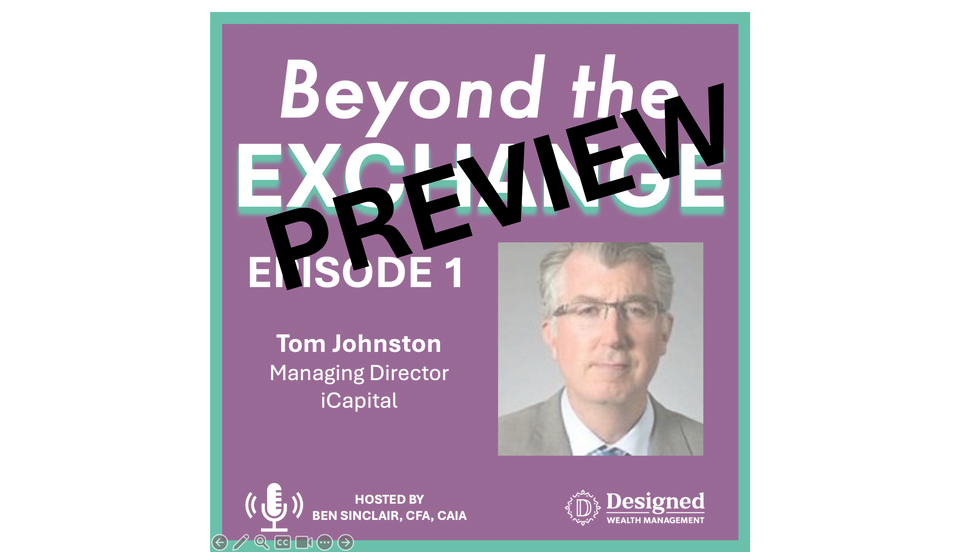
Tom Johnston leads the Canadian Funds business at iCapital, and works to expand access to alternative investment solutions for wealth advisors and institutional clients across the country. Prior to joining iCapital, Tom was President of CI Institutional Asset Management and Head of Canada at UBS Asset Management.
The two of us sat down for a conversation about iCapital's role as private markets become mainstream for individual investors, both in Canada and elsewhere. Below is the first part of the interview:
Ben Sinclair
So, I was wondering if you could take me back to the time before iCapital's founding, before you came on the scenes, what was it like for individual investors to gain access to private market strategies?
Tom Johnston
I would say that it was very much a different scenario than now. There was less choice, number one. Definitely more local players. And you didn't have the full opportunity set of leveraging some of the bigger players in the space, which is very important in alternatives where manager selection is key.
It was very much manual. So there was a very laborious paper driven process. It was not on Fundserv, which a lot of the wealth channels, you know, were used to and automatically integrates into their book of record. And, you know, there was a smaller group.
Ben Sinclair
Take me back then to iCapital's founding in the United States. It was at a time when 60/40 [portfolios consisting of 60% stocks, 40% bonds] was working quite well. Was that a big obstacle for the company when it was first getting off the ground?
Tom Johnston
I would say that the first users, the adopters, those larger book of advisors, they were fairly sophisticated. They saw the upside on the alpha for private equity that it added four or 5% over multiple decades over traditional assets because these managers could go in and create operational efficiency improvements, make some strategic decisions to either acquire and expand growth, divest from businesses that weren't. So that was there. I think that there was a knowledge more of the diversification benefits from adding other asset classes in, and then income.
Ben Sinclair
Okay, taking me back again, was it also a hard sell for the asset managers? Because of course, this was at a time when fundraising was a lot easier. Some managers were even turning away institutional capital at the same time. What was it like going to managers and saying, you should go after the wealth channel now?
Tom Johnston
It's a great question. If we go way, way back, you're right to say 2013 when I say way, way back. A lot of these top managers were doing quite well just with the institutions. But this pool of assets that wealth represents, it's growing to about $145 trillion. It's equal in size with stronger growth. And it allows these GPs [general partners] a way to diversify their investor book.
I think some of them saw the success of some of the pioneers, certainly groups like Blackstone. They had some success and it really portended well for their future growth, for their overall market capitalization. They got a lot of their peers to say, wow, why are we not doing that too? And I think the upside really brought more people on.
Ben Sinclair
The consensus seems to be that it's going to be the big managers who are going to win in this space, the ones who can really make that investment. Or can you really help smaller managers break into the wealth channel too?
Tom Johnston
I think we help everybody. We work with all reputable managers.
Ben Sinclair
And can you talk a little bit about the expansion from the U.S. into Canada at the beginning there, and shortly after that, they brought you on to lead this effort. What were the initial challenges specific to Canada and how did it differ from the US in the beginning?