BTE Newsletter #23: When Private Markets Goes Wrong, Part 3 - What Gating Can Do To Seniors
Good morning everyone, and Happy Tuesday. I hope you had a great Easter weekend.
First, an update on the podcast front. Episode 9 with Jay Simmons of Durum Capital has now been released. He and I had a great conversation on many topics, including Industrial Real Estate, his focus on distressed situations, the advantages of Alberta, and raising money from individual investors. On a related matter, Episode 10 with Julian Klymochko should be out this weekend, and a preview is available below. For those of you who still haven't subscribed, you can use the links below:

|

|
As for the main thought piece in this newsletter, it originated with my Globe and Mail op-ed from a couple weeks ago. An elderly man reached out to me, saying that he is heavily invested in a Canadian private markets fund, and that this fund has suspended redemptions. We met for lunch, he shared his experience, and I concluded it's a story worth telling. After all, senior citizens have unique challenges when investing in these products, especially when things go wrong, and his experience in particular is proof that our system has to evolve.
Ben
A Private Markets Cautionary Tale
For the purposes of this article, we will call this man William, and his story begins approximately 15 years ago, when he was in his sixties (he cannot remember the exact year). He had just lived through the Great Financial Crisis, and was looking for an investment that provided more consistent returns. So when he encountered a particular private markets fund, it seemed like a perfect fit, and the income stream was an added bonus at a time when interest rates had plummeted.
When William made the initial investment, the fund was not an oversized position in his RRSP; he estimates it was about a 10% weight. But over time, the position grew. It helped that the fund provided such consistent returns, but William also admits that he got complacent and failed to rebalance the portfolio. The whole time he had a financial advisor.
Fast forward about a decade, and William's RRSP converted to a RRIF, so he had to start withdrawing money regularly. But at the same time, the world had just endured COVID, Canadian investors were reeling from the Bridging Finance collapse, and redemption pressure was building in private markets. So the fund that William was invested in gated redemptions.
William is now in his late-seventies, and the gated fund accounts for a significant portion of his retirement assets. As a result, he is facing a number of problems.
The Unique Challenges Faced By Seniors in Gated Funds
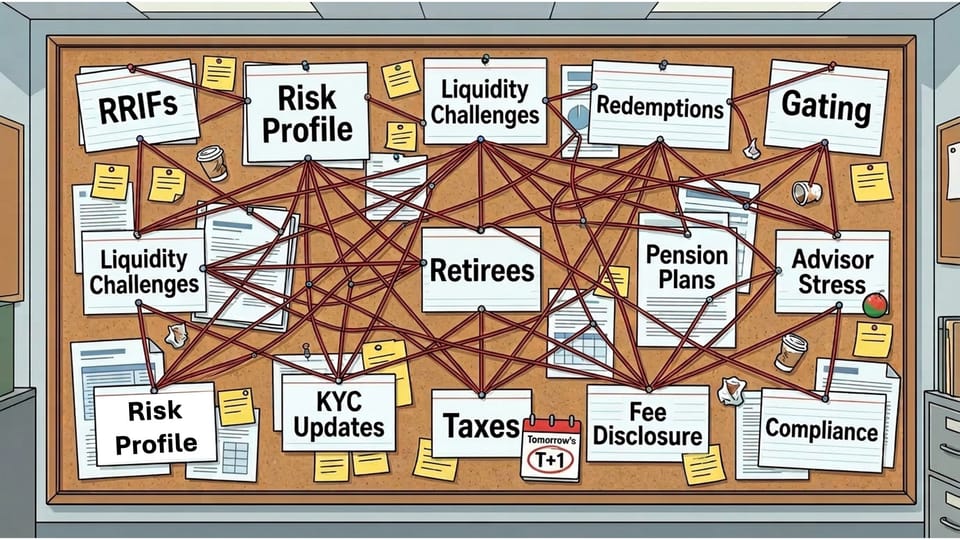
The main challenge is quite obvious: seniors have less time to wait for their money to come back from gated funds. But the problems faced by people like William extend far beyond that:
Minimum Withdrawals and Phantom Tax:
RRIFs come with minimum withdrawals, and in William's case, he must withdraw approximately 6% of his RRIF this year. The good news is that withdrawals can be done in-kind, so he does not need to liquidate a gated fund. The bad news is that RRIF withdrawals are taxable. This isn't such a problem when withdrawing liquid securities, because a portion can be used to cover the tax liability. But when the a significant portion of the withdrawn capital can't be liquidated, that creates a big headache, and a need to fund the tax liability through other means.
Phantom Tax Upon Death:
When William eventually passes, the phantom tax problem will rear its ugly head again, but in a more sinister way. If William is unable to pass on the RRIF assets to a surviving spouse or other qualifying beneficiary, then there is a deemed withdrawal for the entire portfolio. That would come with a big tax liability for the estate, potentially larger than the available liquid assets.
One could even imagine a painfully ironic scenario, in which William names a charity as the RRIF beneficiary to avoid an unaffordable tax liability (but this is not tax advice!).
Everything Is Done at NAV:
If a secondary market existed for this gated fund, then it's quite clear that the trading value would be less than the stated net asset value. But when it comes to statement values, withdrawal requirements, tax liabilities, and the management fee burden, everything is calculated based on net asset value.
So when looking at fees, taxes, and withdrawal requirements as a percentage of the underlying fair market value of the account, that number would be much higher than what is stated.
Spending Needs.
Let's not forget the obvious one. As a senior in his late-70s, William retired years ago, and is thus relying on his retirement savings to fund his livelihood. As he drains the remaining liquid assets in his two RRIFs, he is facing the prospect of having his remaining savings unavailable when they're needed most.
Some Needed Reforms
Unfortunately for William, there's not much he can do to rectify his situation. But there are some rules that could be put in place to help prevent this situation for others:
Limits on Concentrated Positions and Private Markets Exposure
When William first purchased the private markets fund, the position was not oversized. But eventually the position became much too large for his age, liquidity needs, and risk profile.
Clearly in situations like this, there need to be triggers in place to alert the advisor and compel them to rebalance a portfolio as appropriate. If an oversized position is already gated, then this needs to be done on a best-efforts basis.
To ensure accountability, there need to be strong mechanisms that protect clients when suitability failures occur. In extreme cases, one solution would be requiring investment dealers to purchase gated units from the client at net asset value.
Preferential Treatment for RRIF Holders
This is another option that could be considered extreme by some, because most investors in a gated fund can find a reason why they should be prioritized. But in a situation where investors have forced withdrawals combined with cash taxes, there's an argument that funds must prioritize liquidity for RRIF-holders equivalent to their CRA-mandated annual withdrawal requirement, regardless of any active redemption gates.
Fee Waivers
This one may be the least controversial, because when funds are gated, fund managers still receive compensation based on an inflated NAV that is artificially higher than fair value. When a fund cannot find the cash to fund redemptions or even meet cash payouts, that fund should be forced to waive or defer (at least part of) its management fees at the same time.
A Need To Do Better
Because William's true identity is being kept confidential, some people may accuse me of conjuring up this story. And without revealing his identity, there's nothing I can do to prove them wrong.
But there are some facts that even the most ardent skeptics cannot deny:
- Many Canadians are trapped in one or more gated funds.
- Some of these people hold overly concentrated positions, and their financial future is in question as a result.
- There are unique challenges faced by the elderly due to forced withdrawals and cash taxes.
- There need to be proper guardrails in place to prevent this type of story from repeating.
As for William, he seems resigned to his fate. But he is determined to get his story out there, so that others don't find themselves in the same position. This included reaching out to me after reading my Globe and Mail op-ed. The least I can do is tell his story.
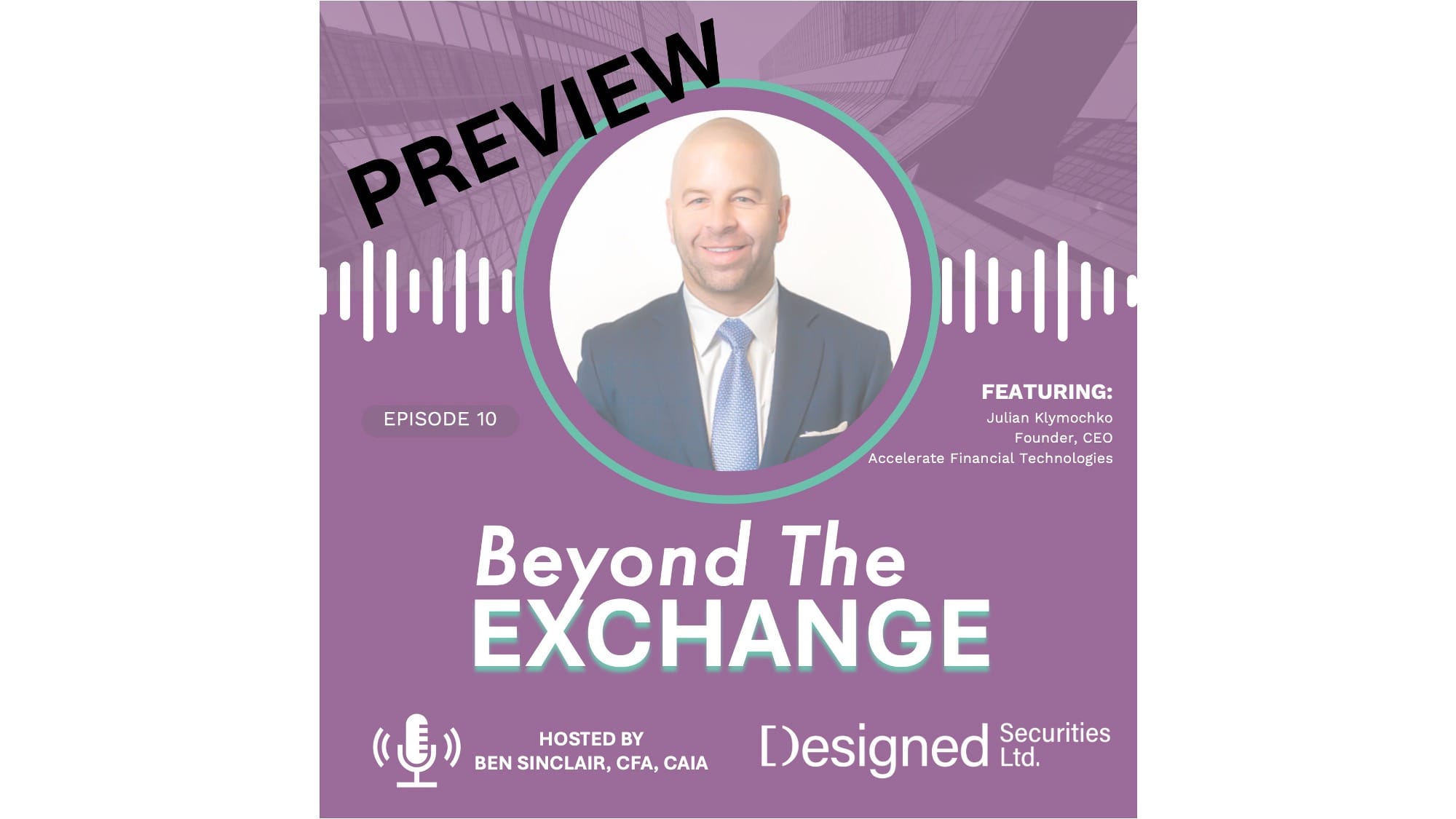
Julian Klymochko, Accelerate Financial Technologies (Preview)
Ben Sinclair
My guest today is Julian Klymochko, founder and CEO at Accelerate Financial Technologies, a leading provider of alternative investment solutions through listed vehicles, with strategies ranging from long short equity, absolute return, multi-asset, alternative income, and private credit. Given all that's going on in the private market space, he's an ideal guest as we try to make sense of it all. Julian, thank you very much for joining me.
Julian Klymochko
Hi Ben, it's great to be on the Beyond the Exchange podcast. Thanks for having me.
Ben Sinclair
Likewise, Julian So can you start by telling me a little bit about your background and how you came into the position that you're in now?
Julian Klymochko
Sure, will do. So it's been a while. I started in the capital markets at a university about 20 years ago. I went into investment banking, started as an analyst, primarily covering mergers and acquisitions, did that for a couple years, and then entered the buy side at a hedge fund in the Great Financial Crisis. It was a very interesting time to invest, particularly in the strategies that we were executing at the time, which were market-neutral arbitrage strategies. It really gave me a good lens in terms of risk management, and how crazy things can get, and how wide spreads can get. We were seeing effectively risk-free returns at nearly 100% annualized at some of the craziest points during the Great Financial Crisis.
I rose up from analyst to PM and launched my first hedge fund. I think I was 28 years old and then rose to CIO. Then in 2018, I left to launch Accelerate, really with a mission of making alternative investments and hedge funds better, faster and cheaper. So our focus was on the liquid alternatives ETF market, which no one had done before. I thought we could offer everything that we were doing in the private markets and do it in a liquid, transparent vehicle that's more competitive on fees and much easier to use for the end client, investment advisors, institutional investors, and even individual investors.
One of the main learnings that I got from the great financial crisis is that in 2008 and 2009, we had really good returns, +7% in 2008, +19% in 2009, very consistent positive returns. Meanwhile in 2008, the index was down about 40% and many people had their portfolios obliterated, and we were running low risk market-neutral hedge funds that actually provided a great diversification benefit. However as you know, these private markets funds were only available to accredited investors. And my attitude was, if someone's worth $50 million and their net worth declines to $25 million, sure that stings, but it's not really going to change their lifestyle too much.
However, if you have a $500,000 portfolio and it gets cut in half, that probably has a material effect on your life plan, such as retirement. So I thought alternative investments, particularly uncorrelated strategies, were necessary in all portfolios, not just for wealthy individuals. I always thought if I could create a vehicle in which everyone could benefit, not just wealthy people, then that would be a positive that I could bring to the market, because I didn't grow up wealthy, so I didn't really have any exposure to that. But I thought it was not a fair thing, so I set out to change that. and managing private funds for 10 years, there are a lot of hurdles and issues that advisors face with respect to illiquidity, high fees, and a lack of transparency.
And I felt with the Exchange Traded Alternative Fund structure, it helped get over those issues. It really made for a more investor-friendly product.
Ben Sinclair
Can you tell me more about those early days at Accelerate? Because you mentioned some of the barriers for individual investors, for people without $50 million investing in these strategies. Of course, one of the other barriers was a lack of familiarity, a lack of education. So what were some of the challenges as you brought that message to the marketplace?
Julian Klymochko
That's a really good question and it's been something that's been happening since the creation of capital markets over a hundred years ago.
I'm a big fan of Ray Dalio's Holy Grail approach, which is basically saying that if you can get 10 strategies that are uncorrelated, the probability of having any losing year is actually very low. So while equities historically have provided a good return, call it 10% over the long term for U.S. equities, that's come with pretty tremendous volatility, well in the mid-teens range, and several times declines of 50%, sometimes even more. The thinking behind the Holy Grail approach is that if you can attain those same returns with a much more diversified portfolio, you don't have to take that volatility. You can generate those same returns with volatility of half or even less, such that you have a much smoother experience, a much more consistent experience.
At Accelerate, we're really trying to provide the tools that investors can utilize to get that Holy Grail approach, so they're not just reliant on stocks, on one risk factor. Then if you look at the typical 60-40 strategic asset allocation portfolio it’s primarily reliant on two factors. You have the equity risk premium and then the duration on the bond side. Periods such as 2022 show that sometimes those risk factors move in the same direction, and stocks and bonds can both be down single digits or double digits. Meanwhile other uncorrelated strategies were up double digits that year.
That's really our mission, to have individual investors, investment advisors, and even institutional investors have the best access point for that diversification, whether it's through merger arbitrage or long-short equity or private credit. There are so many tools out there that many investors aren't incorporating, while on a total portfolio approach basis, each one of those uncorrelated strategies is additive to a portfolio. And that's how it needs to be analyzed. It's always somewhat frustrating when they say, “Oh, the S&P 500 was up and this is down. That means this is a poor product.” But they're not taking into account correlations and volatility and beta and the diversification potential.
And that's why we're real proponents of that total portfolio approach where you analyze each allocation as a tool that hopefully benefits the portfolio at large.
Want to find out more?
Private markets are not for everyone, and come with a number of risks, such as higher illiquidity and less transparency.
However, many of the world’s leading institutions and wealthiest families put a big emphasis on private markets, and recently these strategies have become more available to individuals too. Drawing on my background as an analyst specializing in private markets, I help investors cut through the complexity and understand how to build portfolios incorporating these strategies.
To explore whether these strategies are suitable for you, please schedule a 30-minute virtual meeting below:

Email
|

Phone
|

LinkedIn
|

Apple
|

Spotify
|
Disclaimer
Benjamin Sinclair is a representative of Designed Securities Ltd. Designed Securities Ltd. is regulated by the Canadian Investment Regulatory Organization (ciro.ca) and is a Member of the Canadian Investor Protection Fund (cipf.ca). Investment products are provided by Designed Securities Ltd. and include, but are not limited to, mutual funds, stocks, and bonds. Benjamin Sinclair is registered to provide advice and solutions to clients residing in the province of Ontario. For more information, please see www.beyondtheexchange.ca/disclaimer/