BTE Newsletter #13: David Gens Preview

Hello once again,
For the second week in a row, this newsletter’s feature is a podcast preview, and you can expect plenty more of those going forward. Last week brought a flurry of guest recommendations and requests, so I’ve already started booking recordings into March. My goal is to release new episodes every two weeks, although at times there will be episodes out in back-to-back weeks (episode 5 with Andrea Gruza was released on Sunday, and episode 6 with David Gens should be released this weekend). So stay tuned.

|

|
I also want to share two other ambitions I have for this year. These are feelers for now, but I hope to have a lot more to share throughout the year.
First, I am looking to write guest articles for newspapers and other publications. I feel there’s a real opportunity to add a balanced voice to how private markets are covered. Too often, the press focuses on the extremes, either negative stories that “bleed and lead,” often echoed by traditional asset managers, or overly promotional pieces written by the asset managers themselves. Long-time readers of this newsletter know I write both positive stories and negative stories on this topic. I’d like to bring that same perspective to a broader audience. So if you have a forum where you'd like to add my perspective (or know someone who does), please let me know.
Second, I am looking to do events this year, although the exact type is TBD. It could be webinars, in-person seminars, lunch-and-learns, or any other type of in-person or virtual event where I can share my message. For in-person events, I’m based in Burlington Ontario (but my car gets good gas mileage, so I can cover a lot of ground). If you have any feedback about what type of event you'd like to see from me, again please let me know. And of course, if any of you are running an event and want me to participate (and promote it in this newsletter), I'm all ears.
Ben
BTE Podcast Episode 6 (Preview): David Gens
Ben Sinclair
My guest today is David Gens, CEO of Merchant Growth, an industry-leading financial technology company that provides financing to Canadian small businesses. David founded Merchant Growth in 2009 after recognizing the limited options available to Canadian small businesses outside the banking system. David has also been named top 30 under 30 in BC Business Magazine, top 40 under 40 in Business in Vancouver, and is a two-time finalist in EY's Entrepreneur of the Year.
David, thank you very much for joining me.
David Gens
Really excited to be here, Ben.
Ben Sinclair
So can you talk about the journey to starting your own business? You started Merchant Growth at quite a young age. What led you to even be able to do that or even consider doing that?
David Gens
I knew from a young age that I wanted to be an entrepreneur. There are a lot of entrepreneurs in my family, my brother, my dad, my uncle all have their own companies.
And so those were role models for me growing up. I thought I was going to work in industry for a decade or two before firing up something of my own, but I got the itch quite quickly. I was fortunate to get a great gig working in mid-market private equity in Vancouver after graduating UBC Sauder school. And I came across this growing industry in the US of non-bank small business loans. This is circa 2009.
Back then there was a bit of a mature industry in the U.S. with some large players in it. But when I looked in our own backyard here in Canada, there were very few companies doing these non-bank small business loans based on cash flow. And so I figured, hey, Canada's got some catch-up to do and I'd rather start a business in an area where the wind is at my back.
And so I started making these small business loans and left the private equity firm, left on good terms. My old boss there is an investor with me today. But just got the itch early and figured I'd get started as soon as I had an idea that I felt was viable.
Ben Sinclair
There's lot to unpack there. First, to what extent did the business model or the industry in the U.S. provide a blueprint for what you were looking to do?
David Gens
I would say to a great extent, financial services are similar all over the world, but because of payments, infrastructure, legal, regulatory regime-type stuff, they're different enough that it's a bit hard to just transport a business model across a border.
A tech company like Facebook could just go global right away. We can't really do that with financial services, but the needs are pretty similar globally. So you can look at the US and see that there are a lot of small businesses being left out of their traditional financial institution credit system.
That problem, when I looked at Canada, was even worse up here because we have these five big banks that control 90 % of the market, whereas the US has regional credit unions and a larger number of banks, so they address the need a little bit better down there. But I noticed the gap up here in Canada and knew that there was this opportunity to build something specifically for Canada and that that could over time become a decent business.
Ben Sinclair
How did the dominance of the big five banks here leave small businesses short-changed? To what extent were the banks here not providing small businesses the type of financing that they needed?
David Gens
The fewer number of players you have, the less competitively fierce the environment is going to be. And, they can sort of rest on their laurels and the big brand presence that they have and let the customers come to them. And so they innovate a little bit less and they market a little bit less to especially niche areas, right? Their core businesses, they're great at their core businesses.
But the Canadian banks leave out small businesses a lot. And that's because small business credit is challenging. Every small business looks quite different. There's a lot of risk involved. You have to price that in. You have to be sophisticated about how you do that. It's a lot more complicated than underwriting a consumer for a credit card or a line of credit.
As a result, due to those complexities and the way the regulators look at this type of lending, it's higher-risk lending for the banks, so they have to reserve more equity capital against it, which just makes it more challenging to earn the required return on equity to be in the space. For a whole bunch of reasons, the banks don't play a huge role in this type of small business lending.
And I should probably define what I'm talking about a little bit more here. So if you're a business that does $5 million or above in revenue, at that point, you can talk to commercial bankers and the commercial bankers can build pro-formas and ratios and do some lending based on your cash flow, based on your EBITDA and provide credit that way. If you're under that size and I use $5 million as the line, it's a little bit different bank to bank, but roughly speaking, that's generally where the line is. If you're below that, then the credit solutions available to you are a little bit more more cookie cutter. They’re much less bespoke, with less creativity and flexibility going into those credit products.
And so the small business typically gets asked, ”Do you have any real estate to pledge as collateral?”. That could be real estate in your business or that could be personal real estate or a second home or what have you. And if you have real estate with equity in it, then you can get a line of credit for your business that's secured by that real estate. If you don't have that real estate, equity, then it's maybe a small overdraft in the account, a business credit card with a limit of say $10,000, and away you go.
But you're not going to get $50,000 or $100,000 or $250,000 of working capital or expansion capital to really grow your business based on your cash flows alone. And if you think about most small businesses, most small businesses are asset light, but they have cash flow.
I should also mention that 99% percent of businesses are small businesses. They're about half of our GDP and they're two-thirds of our employment in the entire country. So it's a big space. There are a lot of small companies out there and again most of them being asset light but they have cash flow and hence the large gap that was identified and that we started to approach with our business model.
Ben Sinclair
You can understand to an extent the banks’ reluctance to serve this market because not only are those businesses harder to underwrite, they're difficult to find as well.
David Gens
Very good point. So small business is a tough space regardless of what it is that you're selling, whether you're selling credit or you're selling software or whatever you happen to be selling to small businesses. That market is tough because the customer lifetime value isn't huge. It's decent, but it's not huge because it's a small business.
At the same time, not everyone's a small business owner. So you can't do these mass marketing approaches because if you put up a billboard, the vast majority of people driving by it are not small business owners and the ROI is not going to be there. And so you're having to try and hunt down these prospects, but you have a limited budget with which to do that.
I think a key unlock really over the past 10, 20 years has been digital origination and the ability to market online and market based on intent. So Google of course is a great way to do that. Anytime someone's searching for something like a small business loan, we can ensure we're presented. And just a growing acceptance of digital financial services, business owners actually feeling comfortable with applying for credit with a business that they find through Google or Instagram or what have you, has been a huge unlock.
And so there’s a significant marketing engine that we've built to define those businesses and do so economically. Then of course the key is to make it super easy. That's particularly important when serving small business owners because small business owners are the CMO, the CFO, and the COO. They're doing all the different things to keep the thing running, and they don't have the time to go through a super difficult process to get the credit they need to grow, even if it is pretty important for them. And so the easier you make it for them, the more likely you are to convert them and the more satisfied they'll be with it.
And so we've made it our mission. Our mission statement is fueling the ambitions of Canadian business owners by providing the most accessible, convenient, and trusted financing experience.
So that convenient piece is really what I'm talking about right now. It's about making it as few clicks as possible, permission certain data, allow our system to run, get an offer super quickly, and for the whole thing to be, start to finish within one business day, which is what we've built. This lets that business owner get back to doing what they do best, which is providing the product or service to their customers.
Following Through On His "Zombies" Comment
EQT is one of the largest private equity firms in the world, headquartered in Stockholm, Sweden. Last year its CEO, Per Franzen, made a striking prediction: that “private capital zombie firms” will pile up over the next decade. Shortly after those comments, I wrote about the topic on this site:
 Benjamin Sinclair
The core argument is straightforward. Over the past 10-15 years, private markets have been very welcoming to new entrants, and a wave of fresh managers has flooded in. Now with outsized returns harder to generate, clients consolidating relationships with fewer managers (especially financial advisors and individual investors), and fundraising conditions turning tougher, scale has become more critical than ever. Many firms can survive for a while off fees from past vintages, but they have limited prospects for meaningful growth or relevance, hence the “zombie” label. In many ways the industry would function better with fewer, stronger players.
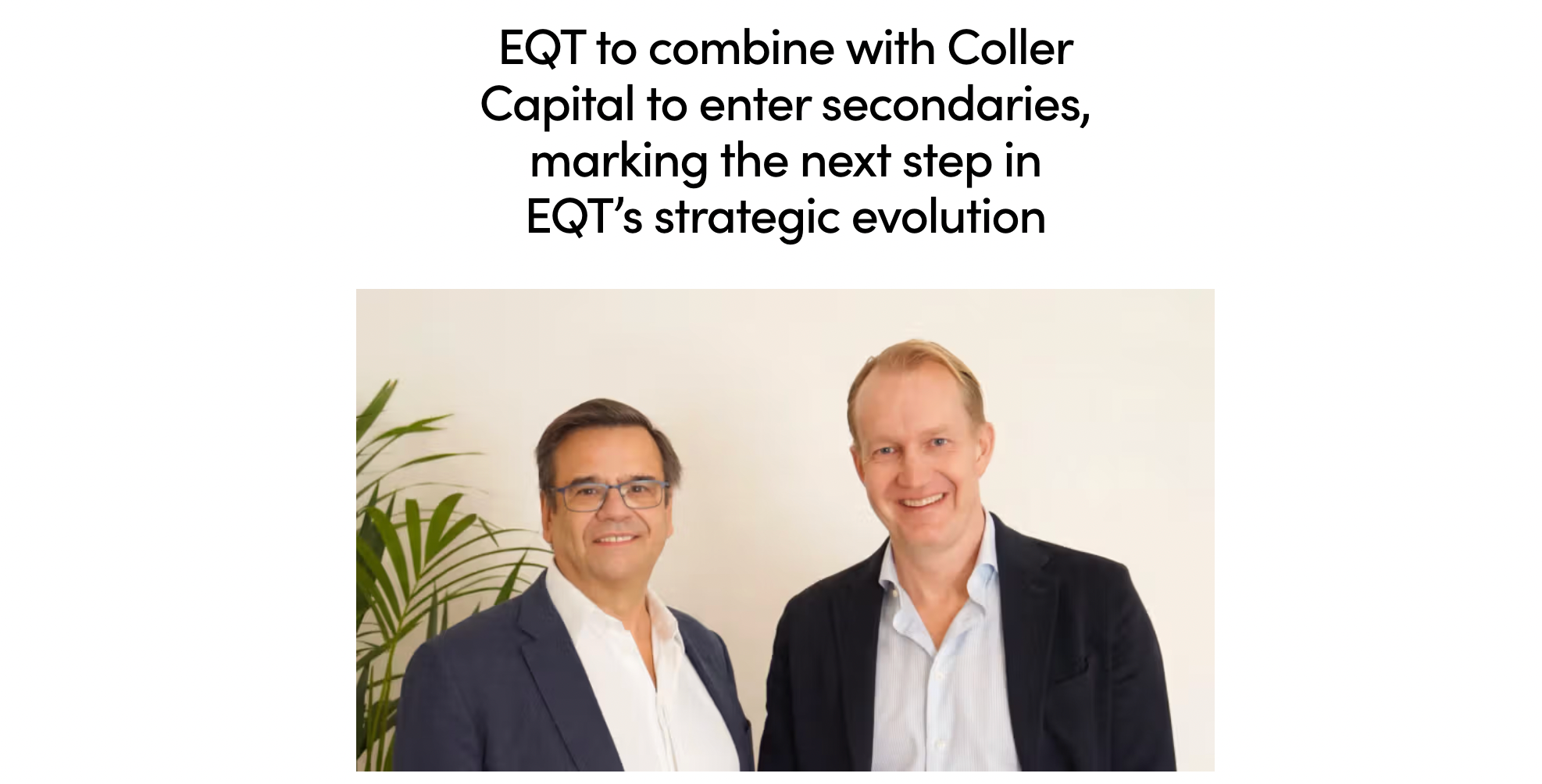
Franzen is now putting (a lot of) his money where his mouth is. EQT is acquiring Coller Capital, a specialist in private equity secondaries, in a deal valued at up to US$3.7 billion. What is notable is that Coller is no laggard; it is a pioneering, high-quality firm with a strong track record. This is not a weak manager being rescued.
That raises an uncomfortable question: if a strong platform like Coller sees value in joining forces with a global giant, what does the future hold for weaker managers? At a minimum, investors should expect a meaningful shakeout in private markets over the coming decade, as firms without scale or clear differentiation struggle to justify their place.
Want to find out more?
Private markets are not for everyone, and come with a number of risks, such as higher illiquidity and less transparency.
However, many of the world’s leading institutions and wealthiest families put a big emphasis on private markets, and recently these strategies have become more available to individuals too. Drawing on my background as an analyst specializing in private markets, I help investors cut through the complexity and understand how to build portfolios incorporating these strategies.
To explore whether these strategies are suitable for you, please schedule a 30-minute virtual meeting below:

Email
|

Phone
|

LinkedIn
|

Apple
|

Spotify
|
Disclaimer
Benjamin Sinclair is a representative of Designed Securities Ltd. Designed Securities Ltd. is regulated by the Canadian Investment Regulatory Organization (ciro.ca) and is a Member of the Canadian Investor Protection Fund (cipf.ca). Investment products are provided by Designed Securities Ltd. and include, but are not limited to, mutual funds, stocks, and bonds. Benjamin Sinclair is registered to provide advice and solutions to clients residing in the province of Ontario. For more information, please see www.beyondtheexchange.ca/disclaimer/